
The Significant Change

Department of Road Transport and Safety
Botswana
Master the Essentials of Safe Driving: Let's Drive Safely
Official Theory & Question Cataloque
for Driving License Class "B" and "EB" including
Call-cab, Taxis, Minibus, Midibus
Master the Essentials of Safe Driving
This online manual is an essential guide for aspiring drivers, offering a clear, concise, and comprehensive approach to learning driving rules and regulations globally, with a focus on Botswana. It includes structured chapters enriched with visual aids, interactive elements, and a strong emphasis on safety. The manual is supplemented with bonus resources such as a glossary, additional materials, and a local DMV directory.
Each chapter concludes with self-assessment exercises to reinforce learning and identify areas needing more attention. The culmination of the manual is a summative self-test designed to mirror the actual driving exam, ensuring thorough preparation. This journey of learning is aimed not just at passing the exam but also at shaping knowledgeable and responsible drivers.
Start Your Journey Today! Unlock the freedom of the open road and to developing your smart driving skills.
Get Started
Remember, this is just the beginning of your learning process. Practice regularly, and don't hesitate to ask questions. Stay safe and enjoy your journey to becoming a confident driver!
All Rights Reserved.
Table of Contents
- Introduction to Driving for Beginners: Pre-License Essentials
- Driver Personality: Reaction to risks
- Traffic Laws, Regulations, and Rules of the Road / Statutory Regulations
- Code of Conduct on the Road: Before You Move, Stay Secure and Aware
- Sharing the Road: Speed / Distance / Warning Signals
- Traffic Management Protocols: Lights, Officers, and Special Cases
- Traffic Road Signs / Traffic Facilities / Level Crossing
- After the Driving Test & Getting your Driving License
- Different Road Users and Driving Manoeuvre's
- Vehicle Parking, Entry, Security, and Towing Procedures
- Smart Parking and Vehicle Safety Guide
- Navigate with Care: Understanding Traffic Conduct and Consequences
- Technical Conditions / Passenger & Goods Transport
- Environmentally Conscious Driving Practices
- Extra Notes: Mastering Vehicle Knowledge
- Bibliography
Introduction to Driving for Beginners: Pre-License Essentials
Pre-License Essentials for Beginners
Welcome to your first driving lesson! This section covers the basics, providing a solid foundation for your journey to becoming a skilled and responsible driver. Driving is a privilege laden with responsibilities, including the safety of yourself, passengers, and other road users. It's crucial to adhere to traffic laws, maintain situational awareness, and be prepared for emergencies. Respect for others, understanding road rules, mastering starting and stopping, and adopting safe driving practices contribute to safe and confident driving.

General Information on Driving Licence Acquisition
-
be at least 18 years old, pass a driving competency test,
-
not have a mental disorder or epilepsy, not be prone to sudden disabling dizziness or fainting,
-
be able to read at a distance of 25 metres a series of 6 letters and figures (with glasses if necessary) similar to vehicle identification marks, and
-
distinguish red, amber, and green colors from 25 metres away.
Essentials Before Obtaining Your Driving License
The "Basic Theory of Driving" handbook is a crucial guide for everyone on Botswana roads, including pedestrians, cyclists, motorcyclists, and drivers. It details The Highway Code, encompassing traffic laws, regulations, signs, and signals, aiming to enhance road safety. Violating these rules can result in fines, demerit points, or even loss of driving privileges. Understanding and adhering to The Highway Code is vital for minimizing road accidents and fatalities.
What is Driving License?
A driving licence is a legal document granted by the Department of Road Transport and Safety under the Road Traffic Act. It identifies the holder, specifies the types of vehicles they can drive, outlines any applicable restrictions or conditions, and indicates the licence's validity period, if relevant.
Fitness to Drive
To be eligible for a driving licence in Botswana, an applicant must meet the following criteria:
Different Class of Driving Licence
| Class | Description | Eligibility |
|---|---|---|
| Class 1 | Motorcycles with engine capacity not exceeding 125cc | 16 years old and above, Pass motorcycle theory and practical tests |
| Class 2 | Motorcycles with engine capacity exceeding 125cc | 18 years old and above, Pass motorcycle theory and practical tests |
| Class 3 | Cars and vehicles up to 7 passengers | 18 years old and above, Pass car theory and practical tests |
| Class 3A | Automatic transmission cars only | 18 years old and above, Pass car theory and practical tests |
| Class 4 | Heavy vehicles such as buses and lorries | 21 years old and above, Pass heavy vehicle theory and practical tests |
| Class 4A | Heavy tow trucks | 21 years old and above, Additional specialized training and tests |
| Class 5 | Very heavy vehicles such as large trailers | 21 years old and above, Must already hold a Class 4 licence |
Proficiency, Validity & Safety
-
Basic Theory Test (BTT): This assesses knowledge of traffic laws, signs, regulations, and road safety. The "Official Handbook - Basic Theory of Driving" contains the relevant material. Passing the BTT is mandatory before advancing to either the Final Theory Test (FTT) or the Riding Theory Test (RTT).
-
Final Theory Test (FTT): For car licence applicants (Class 3 or 3A), passing the FTT is required before attempting the Practical Driving Test. It evaluates understanding of driving safety, techniques, and road user interaction. Success in the FTT allows two years to pass the Practical Driving Test, after which the FTT must be retaken if not passed.
-
Riding Theory Test (RTT): Motorcycle licence seekers (Class 2B) must pass the RTT, focusing on riding safety and techniques, before the Practical Riding Test. A one-year timeframe is given to pass the Practical Riding Test after succeeding in the RTT.
-
Practical Driving/Riding Test: Conducted by a certified examiner, candidates must provide a suitable, insured vehicle. The test assesses the ability to drive or ride safely.
Not exceed 12 demerit points.
Not be under suspension, court disqualification, or one year from licence revocation.
Not be under police investigation.
Not have failed to display a Probation Plate twice or more during probation.
-
Once you pass your BTT, you're eligible to apply for a Provisional Driving Licence (PDL) to begin on-road training with a driving instructor. The PDL is initially valid for two years and can be renewed every two years thereafter.
-
As a PDL holder, you're required to display two 18 cm square 'L' plates on the front and back of your vehicle during lessons and tests, and ensure insurance coverage against third-party risks. Driving is only permitted under the supervision of a licensed instructor.
-
To apply for a PDL, applicants must meet the following criteria:
Not have more than 12 demerit points.
Have passed the BTT.
Be able to read from 25 metres away a series of 6 letters and figures, with glasses if necessary, that match the standard motor vehicle identification mark.
Be able to distinguish red, amber, and green colours from a distance of 25 metres.
-
If you are a Botswana Citizen or Permanent Resident, your driving licence is valid for 5 years. However, for foreigners with a work pass from the Ministry of Foreign Affairs and Labor (e.g., Employment Pass, Work Permit, Dependent Pass with stay restrictions), the driving licence is valid for up to 2 years.
Test of Driving Proficiency
To apply for a new driving licence class, candidates must successfully complete both theory and practical tests, outlined as follows:
To book and take any theory or practical test, applicants must meet these conditions:
Provisional Driving License
Validity of Driving License
Road Safety Tips You Should Know

Personal Requirements: Fitness to Drive
Setting Up & Preparedness to Drive
- What is the recommended hand position on the steering wheel?
Answer:
A. At the 9 and 3 o'clock positions. - What should you do before starting the engine?
Answer:
A. Ensure the car is in neutral or park, check the handbrake, and look around for safety. - Why is adjusting your seat and mirrors important before driving?
Answer:
A. Proper adjustment of your seat and mirrors is crucial for ensuring good visibility and control, which are essential for safe driving. - What are the two things you should always check before turning on the car engine?
Answer:
A. Before turning on the engine, always check that the gear shift is in neutral (or park for automatic vehicles) and that the parking brake is engaged. - Name two items you should have in your vehicle at all times for safety.
Answer:
A. A first-aid kit and a roadside emergency kit (including items like a flashlight, jumper cables, and basic tools). - What should you do if your car starts to skid?
Answer:
A. If your car starts to skid, remain calm, gently steer in the direction you want to go, and avoid slamming on the brakes, as this can worsen the skid. - How often should you check your mirrors while driving?
Answer:
A. You should check your mirrors regularly, about every 8-10 seconds, and always before changing lanes, turning, or stopping. - What is the importance of the 'blind spot' in driving, and how do you check it?
Answer:
A. The blind spot is an area that cannot be seen with mirrors. It's important for safety to check blind spots by quickly glancing over your shoulder before changing lanes or merging.
Physical Ability
- What can be the cause for veering off the roadway?
Answer:
A. Excessive speed B. Inattentiveness, distraction C. Fatigue. - What must you do if you notice signs of fatigue when driving on open stretches of road at night (heavy eyelids, feeling chilly, sudden frights, etc)?
Answer:
A. Interrupt your journey for an adequate break. - How can fatigue be prevented on a long journey?
Answer:
A. By well-timed and sufficient stops for rests
B. Gymnastic exercises during stops. - What can diminish alertness in road traffic?
Answer:
A. Strong emotions (e.g. delight, annoyance, impatience)
B. Animated conversation
C. Engrossing programs on the car radio. - What strongly distracts you while you are driving?
Answer:
A. Telephoning
B. Lighting a cigarette
C. Nagging children on the backseats. - What can prevent you from hearing warning signals?
Answer:
A. Having the radio on too loud
B. Using headphones
C. The exhaust too loud. - What does "power sound" in the result in?
Answer:
A. Signals from other traffic - in particular sirens - are not heard
B. There is noise pollution for others even when the windows are closed
C. Driving errors due to the driver being diverted.
Alcohol, Drugs, Medicines
- A motorist has drunk too much alcohol and for this reason must not drive. How can his fitness to drive not be restored in a short time?
Answer:
A. By sleeping for half an hour B. By drinking two cups of strong coffee C. By going for a half an hour's walk. - Can a motorist's fitness to drive be impaired by even relatively small quantities of alcohol?
Answer:
A. Yes, even small quantities of alcohol can impair fitness to drive. - Which substances can impair fitness to drive in a similar way to alcohol?
Answer:
A. Certain medicines and intoxicants. - What can impair fitness to drive?
Answer:
A. Fatigue
B. Alcohol and other intoxicants
C. Certain medicines. - Above which alcohol level in your blood can you expect your fitness to drive to be impaired?
Answer:
A. 0.3 per mile (30 mg /100 ml). - How long can hashish and its cataboliites (decomposition products) be detected in urine?
Answer:
A. Weeks later. - In general, how long does it take before an alcohol level of 1.0 per mile (100 mg / 100 ml) is cleared from the blood stream?
Answer:
A. 10 hours. - Which of the following are unfit to drive motor vehicles?
Answer:
A. Persons who regularly take drugs (e.g. hashish, heroin, cocaine, weed or marijuana), even if they are not unfit to drive at the time of the journey
B. Persons who smoke a single hashish cigarette per day. - What can increase the intoxicating effect of alcohol?
Answer:
A. Sleeping pills, painkillers or sedatives
B. Drinking on an "EMPTY" stomach
C. Downing alcoholic drinks in one. - May a person who has just smoked a hashish cigaratte drive a motor vehicle?
Answer:
A. No, because he/she could be unfit to drive. - What can be the effects of even small quantities of alcohol?
Answer:
A. Delayed reactions
B. Reckles driving
C. Impairment of hearing and vision. - When is a drug-dependent person fit to drive a motor vehicle again?
Answer:
A. After presenting a proof that s/he has not taken any drugs for a whole year and there is no likehood of a relapse. - What effects can drugs have?
Answer:
A. Intoxication
B. Dependence
C. Addiction. - How is the intoxicating substance in hashish broken down by the body?
Answer:
A. Unevenly over an indeterminate period. - Which drugs can make a person temporarily unfit to drive even when consumed on a single occasion?
Answer:
A. Hasish, marijuana
B. Heroin, cocaine, amphetamines
C. LSD, dagga. - Why are drugs (e.g hashish, heroin, cocaine) still dangerous even if they are just taken on a single occasion?
Answer:
A. They can cause the person to be unfit to drive
B. They can produce intoxication lasting several hours. - What are the consequences for a person driving a motor vehicle under the influence of drugs (e.g. hashish, heroin, cocaine)?
Answer:
A. Confiscation of driving license or driving ban
B. Fine and/or imprisonment
C. Compulsory medical or psychological examination. - What are the possible effects of hashish consumption?
Answer:
A. Intoxication with dangerous hallucination and reduced reaction capability
B. Intoxication with confusion and depression. - What are the possible effects of hashish consumption?
Answer:
A. Diminished awareness of danger
B. Increased likelihood of mistakes in assimilating information
C. Misjudgement of speed and distance. - What are the possible effects of hashish consumption?
Answer:
A. Impaired attention and concentration.
Emotions as Problematic Passengers / Stress
- Immediately before setting off you have felt very angry and you are furious. What is right?
Answer:
A. You should not drive when you are furious. - What do you think of drivers who travel too fast under pressure of time and do not observe speed regulations?
Answer:
A. Pressure of time is no justificationfor ignoring traffic regulations. - A car with a young driver has stopped next to you at a red traffic light. He is playing with his accelerator and obviously intends to start first and shake you off when the lights change. How do you react?
Answer:
A. You ignore the challenge, remain cool and let the other car drive off.
Evaluate Your Understanding & Knowledge on Driving for Beginners
Evaluating your understanding and knowledge after studying the driver's manual ensures you've grasped essential concepts, identifying areas for improvement and boosting your confidence before the official driving test.
Please Click open the Quiz
Self Assessment Quiz
Your Score:
Driver Personality: Reaction to risks
Driver Personality: Reaction to risks
Examining driver personality and risk reaction alongside Botswana's Road Traffic Act, highlighting fundamental rules
Driver Personality: Reaction to Risks: This aspect delves into the psychological characteristics and behaviors of drivers, particularly how individuals perceive and respond to risks while driving. It encompasses factors such as risk tolerance, decision-making under pressure, and reactions to unexpected situations on the road. Understanding driver personality traits is crucial for improving road safety and implementing effective driving interventions.
Botswana's Road Traffic Act: Basic Rules: This section focuses on the legal framework governing road traffic in Botswana, emphasizing essential regulations and guidelines outlined in the Road Traffic Act. It covers fundamental rules and regulations that drivers must adhere to while operating vehicles on Botswana's roads, including traffic signals, speed limits, right-of-way principles, and parking regulations. Compliance with these rules is essential for promoting safe and orderly traffic flow and reducing the risk of accidents.
Overall, the summary highlights the intersection between driver psychology and legal regulations, underscoring the importance of both understanding individual behaviors and complying with legal requirements to enhance road safety in Botswana.
Read MoreBotswana's Road Traffic Act: Basic Rules

Driver Personality & Reaction to Risks
- What makes a good driver?
Answer:
A. He treats others like partners, drives calmly and cooly and refrains from showing that he is superior.
- A car travelling behind is urging you along on a country road. The driver is obviously annoyed that you are travelling slightly slower than is permitted. How do you react?
Answer:
A. You let him overtake as soon as possible and refrain from paying him back for his jostling behaviour.
- What makes a good driver?
Answer:
A. He treats others like partners, drives calmly and cooly and refrains from showing that he is superior.
- A faster car overtakes you on a country road and cuts into your lane. How do you react?
Answer:
A. You control your annoyance, remain cool and proceed as if you had not noticed this action.
- You are overtaking a queue of cars on the Highway. A car approaching very fast is pushing you. The driver flashes his headlights and sounds his horn to show that you should clear his way. What do you do?
Answer:
A. When you are driving fast enough to overtake, you continue at a brisk pace and back into the lane on the left after overtaking
B. If there is a bigger space in the queue which makes getting back into the left-hand lane possible without danger, you let the jostling driver pass. - Drivers who are easily frustrated by other drivers are most likely to:
Answer:
A. Engage in road rage behaviors. - Drivers who are sensation seekers are more likely to:
Answer:
A. Take unnecessary risks and engage in speeding. - Drivers who are highly conscientious are more likely to:
Answer:
A. Plan their trips carefully, obey traffic laws, and prioritize safety. - When encountering a risky situation on the road, the best course of action is to:
Answer:
A. Be aware of your surroundings, anticipate potential dangers, and adjust your driving accordingly. - Drivers who are more fatigued are more likely to:
Answer:
A. Have slower reaction times and difficulty concentrating. - What personality trait is often associated with risky driving behavior?
Answer:
A. Impulsivity. - How might an individual with a high tolerance for risk react in a challenging driving situation?
Answer:
A. Take unnecessary risks to overtake slower vehicles. - Which of the following statements best describes the impact of driver personality on risk perception?
Answer:
A. Risk-tolerant individuals tend to underestimate dangers on the road.
BOTSWANA's Road Traffic Act: Basic Rules
- What should you understand by defensive driving?
Answer:
A. Not insisting on your rights
B. Allowing for other people's mistakes. - What can cause unnecessary obstructions?
Answer:
A. Stalling the engine in the dense traffic
B. Vehicles proceeding too slowly for no good reason
C. Motor vehicles breaking down because they have run out of fuel. - What can present a danger in road traffic?
Answer:
A. Worn tyres
B. Headlights set too high. - What can cause a dangerous road traffic situation?
Answer:
A. Vehicles which have broken down and not been marked safely in accordance with regulations
B. Excessive speed. - Participating in road traffic requires caution at all times and consideration towards other road users. What does this mean for you?
Answer:
A. You must reckon with improper conduct on the part of others
B. You must drive with foresight. - What can cause a dangerous situation?
Answer:
A. Cutting corners
B. Dipping your headlights too late
C. Brakes which engage heavily on one side
D. Too much steering-wheel play. - According to Botswana's Road Traffic Act, is NOT a requirement for all drivers?
Answer:
A. Driving under the influence of alcohol or drugs. - The Botswana Road Traffic Act requires drivers to:
Answer:
A. Give way to pedestrians at crosswalks and marked pedestrian zones
B. Maintain a safe following distance from the vehicle in front. - Speed limits on Botswana's roads are indicated by:
Answer:
A. Posted signage along the roadside. - It is illegal to use a mobile phone while driving in Botswana:
Answer:
A. In all situations, unless using a hands-free device. - In Botswana, drivers are required to:
Answer:
A. Stop completely at a red traffic light and proceed with caution at a yellow light. - What does a red traffic light indicate according to Botswana's Road Traffic Act?
Answer:
A. Stop and wait for the light to turn green. - What is the maximum speed limit on urban roads in Botswana, as per the Road Traffic Act?
Answer:
A. 60 kilometers per hour. - When approaching a pedestrian crossing in Botswana, what should drivers do?
Answer:
A. Slow down and yield to pedestrians waiting to cross or already crossing.
Evaluate Your Understanding & Knowledge on Driver Personality
Evaluating your understanding and knowledge after studying the driver's manual ensures you've grasped essential concepts, identifying areas for improvement and boosting your confidence before the official driving test.
Please Click open the Quiz
Self Assessment Quiz
Your Score:
Traffic Laws, Regulations, and Rules of the Road / Statutory Regulations
Statutory Regulations
Traffic laws, regulations, and rules of the road are a set of legal guidelines that govern the safe and orderly movement of vehicles, pedestrians, and cyclists on public roadways. These regulations are established by a legislature and enforced by law enforcement to ensure the safety of all road users.

Botswana Specific Familiarize yourself with local traffic signs, including regulatory signs (stop, yield), warning signs (pedestrian crossing, animals), and informational signs (directions, services).
Universal Recognize international symbols used in traffic signs, such as the stop sign's octagonal shape and the yield (give way) sign's triangular shape.
Botswana Specific Observe speed limits within cities/towns (usually 60 km/h), on open roads (100 km/h), and highways (120 km/h).
Universal Always adjust speed according to road conditions, weather, and traffic flow, regardless of the posted speed limit.
Botswana Specific Give way to vehicles from the right at uncontrolled intersections. Pedestrians have the right-of-way at marked crossings.
Universal The principle of yielding to emergency vehicles, pedestrians, and when entering a roundabout (vehicles inside the roundabout have the right-of-way) is globally recognized.
Botswana Specific The legal blood alcohol limit is 0.08%. Strict penalties apply for driving under the influence.
Universal Avoid driving after consuming alcohol or drugs. Impaired driving significantly increases the risk of accidents.
Botswana Specific It is mandatory for the driver and all passengers to wear seat belts.
Universal Wearing seat belts is a basic safety measure proven to save lives and reduce injuries in accidents.
Botswana Specific Using a mobile phone without a hands-free device while driving is illegal.
Universal Distracted driving laws generally prohibit texting or calling without hands-free technology.
Botswana Specific Overtake on the right. Ensure the lane is clear and signal your intention. Do not overtake on solid lines.
Universal: Maintain lane discipline. Use signals for lane changes and overtaking. Never overtake in areas with restricted visibility.
Botswana Specific Yield to pedestrians at crossings. Be cautious of cyclists, especially on rural roads.
Universal Share the road respectfully with pedestrians and cyclists. Give them adequate space and priority where required.
Botswana Specific: Observe local parking signs and regulations. Avoid parking in restricted zones or blocking driveways.
Universal: Park in designated areas only. Ensure you do not obstruct traffic flow, pedestrian paths, or emergency routes.
Botswana Specific In an accident, provide aid, exchange information, and report to the nearest police station.
Universal Familiarize yourself with basic first aid, carry emergency contacts, and know the procedure for accident reporting.
Practice Defensive Driving Anticipate potential hazards and keep a safe distance from other vehicles.
Stay Informed Keep up-to-date with changes in traffic laws and regulations.
Be Courteous Respect other road users, including drivers, cyclists, and pedestrians.
Continuous Learning Consider advanced driving courses to improve skills like hazard perception and emergency handling.
Understanding Traffic Signs
Speed Limits
Right-of-Way Rules
Driving Under the Influence
Use of Seat Belts
Use of Mobile Phones
Overtaking and Lane Discipline
Pedestrian and Cyclist Safety
Parking Regulations
Handling Emergencies
or New Drivers
These notes serve as a foundation for understanding the critical aspects of driving safely and legally, both in Botswana and according to universally accepted practices. Always ensure to check the latest local regulations as they may update or change.
Traffic Laws, Regulations, and Rules of the Road / Statutory Regulations
Driving license / Registration Papers
- Which documents must you carry as a driver?
Answer:
A. Driving license
B. Vehicle registration certificate. - When pulled over by a law enforcement officer in Botswana, which of the following documents are you legally required to present?
Answer:
A. Driver's license and proof of insurance. - You are planning to purchase a used car from a private seller in Botswana. To ensure a smooth transaction and legal ownership transfer, which of the following documents should you obtain from the seller?
Answer:
A. A certified copy of the vehicle registration document and a valid roadworthiness certificate
B. The seller's ID and proof of address.
Approval of vehicles / Vehicle tests
-
In which cases must you notify the change of location of a vehicle to the district of another registration centre?
Answer:
A. When the change of location is permanent. -
You have sold your vehicle which is still registered. The buyer has paid. What must you do?
Answer:
A. Inform the registration centre immediately of the buyers name and address
B. Hand over the vehicle registration certificate and vehicle registration book or permit for use to the buyer against receipt. -
What is important with regard to the official registration plates?
Answer:
A. They must be securely attached at the appropriate places
B. They must always be easily legible
C. The rear registration plate must be lit up in darkness. -
What are you allowed to change on the official registration plate?
Answer:
A. Nothing. -
You have bought a vehicle which is registered. What must you do?
Answer:
A. Have it re-registered immediately
B. Submit proof of insurance to the registration authority. -
How can you tell when you must submit your vehicle for the next official inspection?
Answer:
A. By the test stamp
B. By the entry in the vehicle registration certificate. -
You have bought a new car. When is it due for its first official inspection?
Answer:
A. After three years. -
At which intervals must you submit your car (not a new vehicle, petrol engine, G catalytic converter) for the exhaust test?
Answer:
A. Every (( 2 )) years. -
At which intervals must you submit your car (not a new vehicle, petrol engine, without catalytic converter) for the exhaust test?
Answer:
A. Every (( 12 )) months. -
At which intervals must you submit your car (not a new vehicle) with diesel engine for the exhaust test?
Answer:
A. Every (( 2 )) months. -
You have bought a second-hand car. The official inspection has just been carried out. When is it due for its next official inspection?
Answer:
A. After 2 years. -
You have left your registered caravan trailer for six months on a camp-ground. What applies as far as the official inspection is concerned?
Answer:
A. The deadline for submission indicated on the test stamp must be observed. -
What does the hexagonal stamp on the front number plate indicate?
Answer:
A. The date of the next exhaust test. -
You had to obtain an expert opinion because of a technical modification to your vehicle. What are you required to do?
Answer:
A. The certificate on the opinion must be carried or the vehicle document must be corrected. -
Alterations to your vehicle have resulted in the permit for use being cancelled. What are the consequences?
Answer:
A. Fine
B. Entry in the "traffic offender file" (points)
C. The insurance cover lapses. -
The suspension of your motor vehicle has been lowered and an expert opinion must be obtained. When is this required?
Answer:
A. Immediately after the alteration.
Insurances
-
What is required when your vehicle is no longer covered by motor liability insurance?
Answer:
A. The vehicle may no longer be used in road traffic
B. The vehicle must be de-registered at the registration centre. -
Is it important to insure your motor vehicle?
Answer:
A. Yes. -
When considering motor vehicle insurance in Botswana, what are two key factors that typically influence the cost of your premium?
Answer:
A. The make, model and value of your vehicle
B. Your driving record and history of claims -
In Botswana, what are two types of coverage typically included in comprehensive motor vehicle insurance policies?
Answer:
A. Third-party liability, covering damage caused to others
B. Fire and theft coverage for your own vehicle.
Evaluate Your Understanding & Knowledge on Rules of the Road / Statutory Regulations
Evaluating your understanding and knowledge after studying the driver's manual ensures you've grasped essential concepts, identifying areas for improvement and boosting your confidence before the official driving test.
Please Click open the Quiz
Self Assessment Test
Your Score:
Code of Conduct on the Road: Before You Move, Stay Secure and Aware
Traffic Routes: Use, Risks and Importance
Before you set out on the road, prioritize safety and awareness to ensure a secure journey. Adhere to a strict code of conduct that includes preparing your vehicle for travel, observing traffic laws, and staying vigilant of your surroundings. This approach not only protects you but also safeguards other road users, fostering a responsible and respectful driving environment. Remember, secure and aware driving begins with you.

Buckle up first: Secure yourself before anything else.
Mirrors and surroundings: Check your mirrors and glance around for traffic and pedestrians.
Signal, then move: Indicate your intention well in advance, then proceed only when it's safe and without inconveniencing others. Yield to vehicles passing or overtaking you.
Mirror magic: Glance at your mirrors before moving off, slowing down, changing lanes, and making turns. Check them regularly (every 5-10 seconds) while driving.
Blind spots: Don't trust mirrors alone! Turn your head and check over your shoulder before changing lanes, overtaking, turning, or stopping to avoid these unseen areas.
Signal clearly: Let others know your plans with clear and timely signals (at least 3 seconds before your maneuver).
Maintain control: Constantly adjust your speed to the road conditions. This allows you to stop safely in emergencies without losing control.
Reduce when needed: A good driver naturally slows down in specific situations:
Entering built-up areas.
Approaching schools or buses with children boarding or exiting.
Navigating narrow, winding roads.
Seeing children playing nearby.
Approaching bends, hills, or obstructions that limit your view.
Driving on wet roads.
Don't tailgate: Following too closely is dangerous. You risk rear-ending the vehicle in front if they stop suddenly, and you can also stress them out, potentially causing them to make mistakes.
Maintain a safe distance: Allow at least one car length for every 16 km/h of your speed to ensure enough space for a safe stop.
Get ready to roll safely:
Stay informed while driving:
Adapt to the road, not just the limit:
Give everyone space to breathe:
Safe Distance when Driving

Remember, safe driving is all about anticipating risks and taking precautions. By following these tips, you can stay aware, adapt to your surroundings, and navigate the road confidently.
Reversing, Pedestrians, Cyclist Safety, Emergency and General Safe Driving
Always check for children, pedestrians, or obstacles behind you before reversing.
Avoid reversing from a side or minor road onto a main road.
Seek assistance when reversing if your rear view is blocked.
Pedestrians have priority at crossings.
Slow down as you approach a crossing and never overtake.
Be prepared to stop for pedestrians; signal your intentions to other drivers; and take extra care in wet conditions.
Yield to pedestrians at crossings with signals or controlled by police, even if the light is green.
Stop for school patrol wardens' signals.
Be cautious of pedestrians emerging from behind stationary objects, especially near schools and bus stops.
Be extra vigilant for pedestrians on rural roads.
Keep a safe distance from pedestrians and cyclists, and pass them slowly.
Avoid splashing pedestrians when driving through mud or puddles.
Give way to emergency vehicles with sirens or flashing lights by moving to the side of the road and stopping if necessary.
Stay alert for approaching emergency vehicles and signal when moving off the road.
Don't block intersections, follow emergency vehicles closely, stop on bridges, curves, or hills, or brake suddenly in front of them.
cus on the road, using mirrors for brief checks.
Avoid distractions inside the vehicle, including from passengers.
Drive cautiously over steel plates and avoid driving through floods, or dry your brakes after exiting floodwaters.
Slow down near nature areas and where wildlife crossings are marked.
Stay alert for animals on the road, especially at dawn and dusk.
If animals are near the road, slow down as they might cross unexpectedly.
Apply brakes firmly and stay in lane if a collision is inevitable.
After an animal collision causing obstruction, stop, use hazard lights, and call Traffic Police.
Avoid handling injured animals unless sure; move them off the road if safe and inform Traffic Police.
Match your speed to surrounding traffic to avoid congestion.
Yield right-of-way when safe and acknowledge when it's given to you.
Learn local traffic rules when driving in countries with different vehicle orientations.
Signal early and clearly; turn off signals when not in use.
Only use the horn to alert others of danger, not out of frustration or to assert right-of-way.
Stay in your lane and keep to the left unless overtaking.
Choose the correct lane early at junctions and signal turns properly.
Overtake only when necessary and safe.
Maintain queue discipline in traffic and at junctions.
Keep a safe distance from vehicles ahead.
Park considerately without causing obstruction to others.
Ensure all vehicle lights work properly.
Give extra space to pedestrians, cyclists, and motorcyclists, and avoid startling them with the horn.
Remain patient and courteous, avoiding aggressive gestures.
Apologize for mistakes and forgive others on the road.
Safe driving requires full engagement of your senses and awareness of your surroundings. It's crucial to understand, anticipate, and react promptly to different driving situations.
Conditions affecting driving include the driver's state, weather, visibility, road status, and traffic flow.
Driving is influenced by your vision, health, mental condition, and any consumption of alcohol or drugs.
Vision is key, providing 80% of driving information. Regularly scan the environment and mirrors to stay aware.
Tiredness, illness, and emotions like anger or stress can impair focus. Avoid driving if affected.
Alcohol and drugs can significantly reduce your driving capabilities. Never drive under their influence.
Bad weather reduces visibility and vehicle control.
In poor conditions, reduce speed, use headlights, and ensure clear visibility through windows.
On wet roads, stopping distances double due to reduced friction. Avoid hard braking to prevent skidding.
Aquaplaning occurs in heavy rain, losing tire grip. Slow down to regain control.
Both excessive and insufficient light impair vision. Use sunglasses or visors in bright conditions and ensure adequate lighting when it's dark.
Adjust speed according to visibility and conditions.
After driving through water, dry your brakes by pumping the pedal or lightly applying brakes while accelerating.
In flooded conditions, choose an alternative route if depth is uncertain.
On windy highways, reduce speed to maintain control.
Always be prepared for changes and adapt your driving accordingly.
Tyres: Maintain correct pressure and replace tyres with treads under 1.6mm to prevent skidding.
Brakes: Regularly inspect the brake system for leaks, indicating potential serious issues.
Steering: Ensure the steering system is in good condition, avoiding vibration or excessive looseness.
Lights: Keep all vehicle lights functioning properly.
Direction Indicators: Frequently check signal devices for proper operation to avoid accidents.
Horn: Ensure the horn works correctly.
Radiator Coolant: Regularly check coolant levels between 'high' and 'low' indicators when the engine is cool.
Engine Oil: Maintain adequate oil levels and change oil periodically. Use the dipstick to check levels.
Windscreen Wipers: Keep wipers in good condition for clear vision during rain.
Battery: Maintain clean battery terminals and ensure connections are tight. For non-maintenance-free batteries, use distilled water for refills.
Exhaust: Regularly check the exhaust system to prevent excessive smoke and noise and avoid carbon monoxide leakage into the cabin.
Reversing
Pedestrian and Cyclist Safety
Emergency Vehicles
General Safe Driving
Reacting to Animals on the Road
Driving Basics
Signaling and Horn Use
Lane Discipline and Junctions
Overtaking and Queueing
Following Distance and Parking
Vehicle Lights and Pedestrian Safety
Patience and Courtesy
Defensive Driving Techniques
Adverse Conditions Impacting Driving
Driver's State
Weather Conditions
Light Conditions
General Safe Driving Practices
Vehicle Maintenance for Road Safety
Ensure your vehicle remains roadworthy by regularly checking and maintaining key components to prevent accidents:
Code of Conduct Traffic Routes: Use, Risks and Importance
Road Use / Lane Markingss
- Which motor vehicles must, if possible, use the hard shoulder on country roads?
Answer:
A. Farm tractors and working machines driving at low speed
B. Mopeds and invalid carriages. - What are you allowed to use the left-hand hard shoulder for?
Answer:
A. Stopping and parking
B. Driving with slow vehicles. - You are driving in dense fog on a road outside a built-up area. Are you allowed to drive in the middle of the road continuously straddling the broken white line?
Answer:
A. No, because it could represent a danger to oncomng traffic. - You are driving on a road outside a built-up area with three lanes in each direction. Individual vehicles are travelling well spaced out in the left-hand lane. Which lane may you use continuously?
Answer:
A. The middle lane. - Which motor vehicles may freely choose their lane inside built-up areas?
Answer:
A. All motor vehicles with a permissible total mass of up to (( 3.5 )) t. - In which cases are you allowed to drive faster on the left-hand side than on the right-hand side of roads with marked lanes?
Answer:
A. When queues of vehicles have formed
B When arrows in the individual lanes point in different directions.
Motorways and vehicles - only roads
- What leads frequently to serious accidents when overtaking on Highways?
Answer:
A. Not keeping a close enough eye on the traffic situation behind
B. Driving too close to the vehicle in front. - Are you allowed to overtake the black car on this Highways on the left?
Answer:
A. No, because there is no queue of vehicles in the right lane. - What must you reckon with on this Highway car park?
Answer:
A. People suddenly stepping onto the roadway
B. Danger of skidding when you brake. - After a long journey at about 120 km/h, you want to leave the Highway. What must you remember?
Answer:
A. Indicate in good time and reduce speed on the exit lane
B. Check the speedometer to ensure that you do not underestimate your speed. - You are approaching the vehicles in the picture. What do you do?
Answer:
A. Stay in the middle lane, reduce speed and do not overtake the cars. - You are driving at least 20 km/h faster than the truck. What is correct?
Answer:
A. Overtake the truck on the left and join the Highway. - You want to leave the Highway. The next exit has an exit lane. What must you do?
Answer:
A. Use the left-hand lane early enough and indicate in good time
B. Reduce and check speed in the exit lane. - What must you do here?
Answer:
A. Check your speed again and, if necessary, brake. - What must you reckon with here?
Answer:
A. A traffic jam on the bend
B. The bend will narrow. - What must you remember when you join the Highway?
Answer:
A. The traffic on the Highway has priority
B. You may drive faster in the accelerating lane than in the Highway lane. - You want to join the driving lane of the Highway from the accelerating lane. Where must you stop, if necessary, on the accelerating lane, if you cannot join because of the high traffic density?
Answer:
A. Toward the end of the accelerating lane. - What do you do if a driver is following you closely on the Highway and urges you constantly by flashing his headlights to clear the overtaking lane?
Answer:
A. You move over to the left lane as soon as possible. - While your are stationary in a traffic jam, you see in the rear-view mirror that a motorcyclist ignores the regulations and is threading his way through. What do you do?
Answer:
A. You allow him/her to pass. - You want to quickly overtake a queue of cars on the Highway. A car travelling at lower speed stops you from doing so. You are annoyed and frustrated. What do you do?
Answer:
A. You control yourself and wait until overtaking is possible. - In which cases are you allowed to drive faster on the left lane than on the right?
Answer:
A. When queues of vehicles have formed in thick traffic
B. When you want to join a motorway in an acceleration lane. - What is the recommended speed that applies to cars and motorcycles on the Highway?
Answer:
A. (( 120 )) km/h. - You are driving in the acceleration lane. What do you do?
Answer:
A. Accelerate adequately, if possible, avoid stopping, observe priority and filter into the stream of traffic
B. Pass vehicles travelling more slowly in the driving lane on the left and filter into the stream of traffic in front of them. - What must you do in a traffic jam on two-lane clearways for motor vehicles only?
Answer:
A. Vehicles driving on the right must keep well over to the right and vehicles driving on the left must keep well over to the left so that a channel is let clear for emergency vehicles. - You are driving in the right of two lanes and approaching a vehicle that has just started to overtake. What do you do?
Answer:
A. Keep an adequate distance behind the vehicle in front
B. Allow the vehicle in front to overtake. - You are driving on the Highway in light traffic. How long are you allowed to stay in the right-hand lane?
Answer:
A. As long as is necessary to overtake other vehicles
B. As long as you are driving behind a vehicle which is overtaking in the right-hand lane. - You have missed the Highway exit. What do you do?
Answer:
A. Drive on to the next exit. - What applies on clearways for motor vehicles only?
Answer:
A. No U-turns
B. Join the clearway only at crossroads and junctions. - What top speed must be entered in the vehicle documents to allow the vehicle's use on Highways?
Answer:
A. More than (( 60 )) km/h. - A traffic jam has formed on a three-lane Highway. Where must the channel for emergency vehicles be formed?
Answer:
A. Between the right-hand and the middle lanes. - Your vehicle has broken down on the Highway. What must you remember when having it towed away?
Answer:
A. You must leave the Highway at the next exit
B. During towing, both vehicles must have their hazard warning lights switched on. - What applies on Highways?
Answer:
A. No stopping on the roadway and hard shoulder
B. No reversing. - What is the maximum speed at which you are allowed to drive a car with a trailer on thte Highway?
Answer:
A. (( 80 )) km/h.
Evaluate Your Understanding & Knowledge on Code of Conduct on the Road
Evaluating your understanding and knowledge after studying the driver's manual ensures you've grasped essential concepts, identifying areas for improvement and boosting your confidence before the official driving test.
Please Click open the Quiz
Self Assessment Quiz
Your Score:
Sharing the Road: Speed / Distance / Warning Signals
Road Safety Essentials: Navigating Sharing, Parking, and Emergencies
Sharing the road responsibly demands mindful attention to speed, maintaining safe distances, and proper use of warning signals. By adhering to speed limits, you ensure your own safety and the safety of others. Keeping an adequate distance from other vehicles allows for unexpected events, and using warning signals communicates your intentions, preventing accidents. These practices are foundational to a harmonious and safe road-sharing environment, where respect and caution pave the way for everyone's security.

Sharing the Road :: Key Points
Respect All Road Users: Recognize that the road is shared with drivers, cyclists, pedestrians, and motorcyclists. Each has the same right to use the road safely.
Stay Aware of Bicycles and Motorcycles: They have a smaller profile and can be harder to see, especially in your vehicle's blind spots. Give them plenty of room when passing and check mirrors before changing lanes or turning.
Pedestrian Safety: Yield to pedestrians at crosswalks and be cautious in urban areas where foot traffic is high. Be especially attentive near schools and residential areas.
Large Vehicles: Trucks and buses have larger blind spots and require more room to maneuver. Be patient and give them the necessary space, especially when they're turning.
Road Sharing Etiquette: Use signals early, maintain a safe distance, and avoid aggressive driving behaviors like honking, speeding, and road rage.
Parking Safely: Always park in designated areas, observing any restrictions. Ensure your vehicle does not obstruct traffic, pedestrian paths, or driveways.
Reversing Precautions: Before reversing, check for obstacles or moving vehicles. Use mirrors and, if necessary, turn to look directly behind your vehicle. Move slowly and stop immediately if you're unsure.
Use of Technology: Modern vehicles often come equipped with reversing cameras and sensors. While helpful, they should not replace manual checks.
Parallel Parking: Master this skill through practice in a safe, low-traffic area. Always signal your intentions and move slowly, checking all sides.
Exiting a Parking Space: Be mindful of pedestrians and other vehicles. Signal your exit and wait until the way is clear.
Vehicle Breakdown: If your vehicle breaks down, signal and move to the side of the road safely. Use hazard lights to warn other drivers, and place a reflective triangle behind your vehicle if available.
Accidents: In the event of an accident, check for injuries and call emergency services if needed. Exchange information with the other driver(s), and take photos of the scene for insurance purposes.
First Aid: Knowing basic first aid can be lifesaving. Consider taking a course to prepare for any injuries you or your passengers might sustain.
Emergency Equipment: Keep an emergency kit in your vehicle that includes a first aid kit, flashlight, blanket, and basic tools.
Dealing with Aggressive Drivers: Stay calm, avoid eye contact, and do not respond to aggression with aggression. Focus on your safety and consider reporting them if they pose a danger to others.
Parking & Reversing :: Key Points
Handling Emergencies :: Key Points
Important Notes !!!
Understanding how to share the road, safely park and reverse your vehicle, and handle emergencies are essential skills for new and beginner drivers. These practices not only ensure your safety but also the safety of all road users. Remember, safe driving is responsible driving.
Sharing the Road: Speed / Distance / Warning Signals
Speed / Statutory regulations
- Why must you not drive extra slowly for no reason?
Answer:
A. Because it obstructs the flow of traffic
B. Because it increases the danger of rear-end collisions
C. Because it encourages vehicle drivers behind to overtake dangerously. - What must you be prepare for?
Answer:
A. Pedestrians often change the side of the road
B. Parking vehicles obstruct your view
C. Pedestrians sometimes step into the roadway inattentively. - What must you reckon with?
Answer:
A. Pedestrians and particularly children may suddenly step onto the roadway between the parked vehicles
B. Doors are often opened carelessly on the side of the roadway
C. Vehicles setting off swerve out unexpectedly. - What must you reckon with?
Answer:
A. Pedestrians could step onto the roadway in front of you
B. Children may suddenly appear from between the vehicles. - Where must you particularly reckon with dirt on the roadway and therefore danger of skidding?
Answer:
A. Near construction sites
B. At junctions with farm tracks. - Why must the safe distance maintained be much greater on a wet roadway than on a dry roadway?
Answer:
A. The contact between the tyres and the roadway deteriorates
B. Wheel-spray can impair visibility
C. Braking distances are greater. - Where must you especially reckon with obstacles on the roadway?
Answer:
A. On bridges
B. On stretches of road running through forest. - Why should you drive with particular care here?
Answer:
A. The road ahead is obscured from view
B. The surface of the road is uneven
C. Oncoming traffic might drive too far on the right. - Why does driving on this stretch of road require greater alertness on the part of the motorist?
Answer:
A. The road surface is uneven and road grip varies
B. A vehicle might come from the opposite direction
C. Driving on the tracks is dangerous. - Why is it necessary to maintain a particularly great safe distance from vehicles in front?
Answer:
A. Because otherwise wheel-spray impairs visibility
B. Because the stopping distance is greater than on a dry road
C. Because otherwise you might react too late to puddles. - What adversely affects road safety in this situation?
Answer:
A. Water thrown up by vehicles in front
B. The fog tail lamps of the car in front. - The road is muddy for a short distance.What should you avoid here, if possible?
Answer:
A. Accelerating
B. Braking
C. Steering wheel movements. - While driving, how can you safely check whether the road is slippery?
Answer:
A. By carefully applying the brakes at very low speed. - You are driving against oncoming traffic on the road deeply covered in sand. The roadway has been cleared by a bulldozer. What must you reckon with?
Answer:
A. Pedestrians are often not able to leave the roadway because of piled-up dirt and therefore make the roadway even narrower
B. You may only drive at a speed which excludes any danger for pedestrians. - What dangers could arise if you want to turn right here?
Answer:
A. You might not be able to stop in time if a pedestrian crosses the side street
B. Vehicles coming out of the side street might go into a skid on braking
C. Your vehicle could go into a skid on turning too fast. - Why must you drive with particular caution here?
Answer: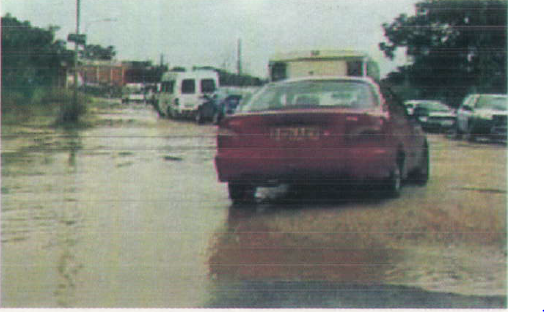
A. Because the roadway is slippery
B. Because the view is obscured by the bend
C. Because the roadway is made narrower by the wrongly parked car. - Where must you be prepared to encounter sudden fog?
Answer:
A. Near rivers
B. In marshy areas
C. Near lakes. - Why can driving along this unevenly lit street be dangerous?
Answer:
A. Pedestrians crossing the street in a dark area can easily be overlooked
B. Badly lit vehicles are difficult to make out in dark areas. - What must you reckon with here?
Answer:
A. Others cannot see your vehicle in good time
B. You only see oncoming vehicles late
C. Traffic lights hardly stand out from the coloured neon signs. - Where does driving fast often lead to accidents?
Answer:
A. At crossroads and junctions
B. At pedestrian crossings
C. On bends. - Where is fast driving particularly dangerous?
Answer:
A. At blind spots
B. At road narrowings
C. At level crossings. - How do you take tight bends?
Answer:
A. Reduce speed before reaching the bend
B. Only accelerate again when the road straightens out. - Which dangers can arise in this residential area?
Answer:
A. Vehicles drive too fast
B. Junctions are ignored
C. Children may run into the road unexpectedly. - What must you reckon with here?
Answer:
A. A vehicle moving slowly in your direction behind the bend
B. Fast oncoming traffic cutting the bend
C. Game pass. - What must you be prepared for?
Answer:
A. The appearance of a vehicle from the left
B. A longer braking distance on account of the wet road. - Why must you be particularly careful here?
Answer:
A. Bacause there is an increased danger of skidding when braking
B. Because a vehicle could come from the right. - What must you reckon with the brow of this hill?
Answer:
A. A vehicle may have broken down there
B. A vehicle coming from the other direction may be straddling part of your lane
C. A slow-moving vehicle may be on your lane. - What must you reckon with here?
Answer:
A. With a dangerous right bend
B. With a vehicle stopped behind the top of the hill. - What must you be prepared for in this situation?
Answer:
A. An uneven and dirty roadway
B. Workers and construction equipment on the roadway. - What must you reckon with in this situation?
Answer:
A. Vehicles may suddenly brake
B. You may need a longer braking distance than normal. - Which dangers must you reckon with above all in rural areas?
Answer:
A. Soiled roadways
B. Slow farm vehicles
C. Excessively wide farm vehicles. - With which road users must special care be taken?
Answer:
A. With handicapped and elderly pedesttrians and other pedestrians requiring assistance
B. With children
C. With cyclists whose riding shows they are unsure of themselves. - What is the permissible top speed generally in built-up areas?
Answer:
A. (( 60 )) km/h. - What must you take into consideration when selecting your speed?
Answer:
A. Visibility and weather conditions
B. The condition of the road and traffic situations
C. Personal driving ability. - What kind of driving results in high fuel consumption?
Answer:
A. Fast starts and unnecessary acceleration
B. Revving up all gears
C. Driving at high speed. - How can you cover more kilometers on less fuel?
Answer:
A. Accelerate in such a way that the highest possible gear is quickly reached
B. Think ahead when driving in order to avoid unnecessary acceleration and braking. - Why must you be particularly careful when driving a vehicle with which you are unfamiliar?
Answer:
A. Because you might not be familiar with the controls and dimensions of the vehicle
B. Because you do not yet know how the vehicle reacts to braking
C. Because you do not yet know how the vehicle behaves on bends at higher speeds. - What can cause skidding on bends?
Answer:
A. Heavy braking
B. Driving fast on a wet roadway. - What can result in aquaplaning (sliding on wet roads)?
Answer:
A. High speed
B. Worn tyres
C. Grooves in the roadway. - What must you do if your vehicle is caught by a strong side wind?
Answer:
A. Steer against the wind
B. Reduce speed. - Where must you be particularly prepared for dangerous side winds on the Highway?
Answer:
A. On bridges
B. Behind cuts in the landscape. - When can strong side wind be particularly dangerous?
Answer:
A. When overtaking trucks
B. When driving across bridges
C. When driving past fire breaks in forests. - What must you reckon with in this situation?
Answer:
A. Your vehicle could be blown to the right by the strong side wind
B. When overtaking, your vehicle is pulling to the left when you enter the slipstream of the truck. - A strong side wind is blowing from the left. When are you particularly exposed to danger when overtaking?
Answer:
A. When you enter the slipstream of the truck
B. When you leave the slipstream of the truck. - Why must you reduce your speed in heavy rain?
Answer:
A. Because braking distance is increased
B. Because visibility is reduced
C. Because aquaplaning (sliding on wet roads) can occur. - What adversely affects road safety here?
Answer:
A. Poor visibility
B. Reduced grip of the tyres on the wet roadway. - What can be caused if the road surface suddenly becomes worse?
Answer:
A. Danger of sliding and skidding
B. Changes in tyre noise. - What must driver of the white car reckon with?
Answer:
A. Oncoming traffic may cut the corner
B. A vehicle may have broken down beyond the bend
C. Game animals could suddenly appear. - Where does aquaplaning (sliding on wet roads) occur particularly often?
Answer:
A. In dips in the roadway
B. Where there are grooves in the roadway. - What does aquaplaning (sliding on wet roads) lead to?
Answer:
A. The vehicle can no longer be steered and braked
B. The vehicle can leave the road. - What must you reckon with when it starts raining after a long period of dry weather?
Answer:
A. A dangerous greasy film on the surface of the road
B. Bad visibility immediately upon switching the windscreen wipers on. - What must you do on encountering sudden dense fog driving at daytime?
Answer:
A. Adapt speed immediately to visibility conditions
B. Switch on dipped headlights. - You are driving on a country road in darkness and rain and encounter oncoming vehicles with dipped headlights. What must you remember?
Answer:
A. You can be dazzled by reflections on the wet road
B. Your wet windscreen can result in you being dazzled. - You have been driving at high speed for some time. What effects can this have?
Answer:
A. You lose your feel for speed
B. Your powers of concentration diminish. - What can result from driving for a long time at high speed?
Answer:
A. You lose your feel for speed
B. You drive too close to vehicles in front. - You are travelling at high speed. Where in particular can obstructions suddenly appear?
Answer:
A. In woodland areas (game animals crossing)
B. Behind hilltops. - You have been driving at high speed for some time. What effects can this haveWhen is there a danger of underestimating your own speed?
Answer:
A. When the road is wide and there are no trees, buildings, fences etc. at the edge of the road
B. When you have already been driving at high speed for some time. - YWhat can lead you to dangerously underestimate your own speed?
Answer:
A. Driving for a long time at high speed
B. Driving on a good, wide road. - What must you do?
Answer:
A. Drive slowly because children might run out from between the parked vehicles at any time
B. Drive slowly because a door on one of the vehicles could be opened on the roadway side. - What could cause a fast travelling motor vehicle suddenly to veer sideways on a dry straight road?
Answer:
A. If it is suddenly hit by a gust of strong side wind
B. A burst tyre. - You are driving into a left-hand bend. A motorcyclist is approaching you at high speed. What must you reckon with?
Answer:
A. The motorcyclist could project into your lane with the upper part of his body, because he is leaning over at a steep angle. - Why does environment friendly driving in general have a beneficial effect on traffic safety?
Answer:
A. Because drivers think ahead when travelling, so that possible dangers can be recognised in time and well avoided
B. Because environment friendly friendly driving avoids high speeds so that dangerous situations occur less frequently. - For which motor vehicles is the recommended Highway speed intended?
Answer:
A. For cars and motorcyclist
B. For trucks with a permissible total mass of 3.5 t. - To which roads does the recommended speed of 120 km/h apply?
Answer:
A. Highways
B. Roads outside built-up areas with physically separate roadways for each direction
C. Roads outside built-up areas with at least two marked lanes in each direction. - You have driving in fog on the highway and have 50 m visibility. What is the maximum speed you may drive?
Answer:
A. (( 50 )) km/h. - You are driving on a narrow road and can see 50 m ahead. What must be your maximum stopping distance?
Answer:
A. (( 25 )) km/h. - You are driving on a good road. Visibility is good. Within what distance must you be able to stop at the latest?
Answer:
A. Within the range of vision. - You are driving at night with dipped headlights on a good country road. Within what distance must you be able to stop at the latest?
Answer:
A. Within the range of the dipped headlights. - What is the maximum speed a motor vehicle fitted with twin-wheels is allowed to travel?
Answer:
A. (( 80 )) km/h. - What is the maximum speed you are allowed to drive a truck and trailer with permissible total mass of 3.6 t on country roads outside built-up areas?
Answer:
A. (( 80 )) km/h. - What is the maximum speed you are allowed to drive a car with trailer on country roads outside built-up areas?
Answer:
A. (( 80 )) km/h. - What is the maximum speed you are allowed to drive a car on roads with one marked lane for each direction outside built-up areas?
Answer:
A. (( 120 )) km/h. - What is the maximum speed you are allowed to drive a truck with a permissible total mass of 7.5 t on roads with one marked lane for each direction outside built-up areas?
Answer:
A. (( 80 )) km/h. - What is the maximum speed a truck with a permissible total mass of 8.0 t and trailer may be driven on Highways?
Answer:
A. (( 80 )) km/h. - On a clearway for motor vehicles only, there is a sign "recommended speed 100 km/h". What is the maximum speed at which a car towing a trailer may travel?
Answer:
A. (( 80 )) km/h. - What are the effects of driving at high speed?
Answer:
A. Increased fuel consumption
B. Increased pollutant emission. - How can you reduce noise?
Answer:
A. By driving in 4th or 5th gear in built-up areas. - By which percentage does the fuel consumption (liter/100 km) of a middle-class car driving at 160 km/h in general increase compared to driving at the recommended speed of 120 km/h?
Answer:
A. By up to 35 %. - What does a front-wheel drive car tend to do if you accelerate too much on a bend?
Answer:
A. The front end tends to turn out to the side. - What does a rear-wheel drive car tend to do if you accelerate too much on a bend?
Answer:
A. The rear end tends to turn out to the side.
Stop
- Which factors lengthen your braking distance?
Answer:
A. Towing a trailer not fitted with brakes
B. A wet or slippery roadway
C. Driving down slopes. - What does the braking distance depend on?
Answer:
A. The condition of the tyres
B. The condition of the braking system
C. The condition of the road surface. - You double the speed at which you are travelling. How does this affect the braking distance?
Answer:
A. It is (( 4 )) times as long. - By which rule of thumb can you determine from the speed the distance in meters a motor vehicle travels in one second?
Answer:
A. (( speed in km/h ) / 10) x 3. - By which rule of thumb can you determine the braking distance in meters from speed?
Answer:
A. (( speed in km/h ) / 10) x (( speed in km/h ) / 10). - You are driving on a narrow road. A pedestrian suddenly steps anto the roadway 20 m ahead of you. When, by the rule of thumb, can a collision not be avoided?
Answer:
A. At a speed of 40 km/h. - You have a reaction time of 1 second. Which stopping distance must you reckon with by rule of thumb if you travelling at 100km/h?
Answer:
A. (( 130 )) m. - How long is the braking distance by rule of thumb when you are travelling at 100 km/h?
Answer:
A. (( 100 )) m. - You have a reaction time of 1 second. What is the reaction distance by rule of thumb if you are travelling at 100 km/h?
Answer:
A. (( 30 )) m. - You have a reaction time of 1 second. Which stopping distance must you reckon with by rule of thumb if you are travelling at 50 km/h?
Answer:
A. (( 40 )) m. - How long is the braking distance by rule of thumb when you are travelling at 60 km/h?
Answer:
A. (( 36 )) m. - You have a reaction time of 1 second. What is the reaction distance by rule of thumb if you are travelling at 60 km/h?
Answer:
A. (( 18 )) m.
Distance
- What can be the causes of rear-end collisions?
Answer:
A. Unexpectedly heavy braking
B. Inattentiveness
C. Driving too close behind the vehicle in front. - You are driving in a built-up area behind a vehicle with foreign number plates.What should you be prepared for?
Answer:
A. The driver in front could brake unexpectedly
B. The driver in front may switch on the direction indicators too late, just before a turn
C. The driver in front could stop unexpectedly to ask the way. - What do you do if visibility is drastically reduced by fog?
Answer:
A. Adapt your speed in time to visibility conditions
B. Increase the distance from the vehicle in front. - What does the distance to be maintained from the vehicle ahead depend on?
Answer:
A. Visibility conditions
B. Speed
C. State of the road surface. - It starts raining. Why must you immediately increase the safe distance?
Answer:
A. Because a greasy film may form which increases the braking distance
B. Because visibility may may become worse and the windscreen wipers do not immediately provide a clear field of vision. - You are driving on a country road in a stream of traffic. What must you do?
Answer:
A. Observe the safe distance. - What makes driving in a stream of vehicles easier?
Answer:
A. Watching the queue through the windows of the vehicles travelling in front
B. Driving in a slightly staggered position in your own lane. - What is the minimum distance that should normally be maintained from the vehicle in front outside built-up area?
Answer:
A. 1/2 the speedometer reading in meters. - You are driving in urban traffic on a dry roadway in a stream of traffic travelling at a speed of 50 km/h. What is the minimum safe distance you must keep from the vehicle in front?
Answer:
A. 15 m or approximately 3 car lengths.
Warning Signals
- What do hazard warning lights draw your attention to?
Answer:
A. To vehicles which have broken down
B. To school buses with children boarding or alighting
C. To a traffic jam
D. Potholes ahead. - What must you reckon with when you see a hazard warning light flash?
Answer:
A. With a school bus with children alighting
A. With a car being towed
A. With a truck broken down. - For which purposes is a horn allowed to be used outside built-up areas?
Answer:
A. As a warning signal
B. As an overtaking signal. - For which purposes is a horn allowed to be used in built-up areas?
Answer:
A. As a warning signal. - Where is it permitted to flash headlights to indicate your intention to overtake?
Answer:
A. In daylight outside built-up areas
B. In darkness outside built-up area.
Evaluate Your Understanding & Knowledge on Sharing the Road
Evaluating your understanding and knowledge after studying the driver's manual ensures you've grasped essential concepts, identifying areas for improvement and boosting your confidence before the official driving test.
Please Click open the Quiz
Self Assessment Quiz
Your Score:
Traffic Management Protocols: Lights, Officers, and Special Cases
Right of way/Traffic control by lights/Traffic control by police officers/special Situations
Traffic management protocols, including the observance of traffic lights, adherence to directions from traffic officers, and navigating special cases such as emergency vehicle passage, are essential for maintaining order and safety on the roads. Respecting traffic signals ensures smooth flow and prevents accidents, while obeying traffic officers' instructions supports the enforcement of local traffic laws. Special attention to emergency responses, like yielding to emergency vehicles, underscores the collective responsibility to facilitate urgent services. These protocols are crucial for efficient traffic management and the safety of all road users.

Impaired Judgment and Decision Making Alcohol and drugs can severely impair your ability to make sound judgments and decisions, increasing the likelihood of risky behavior on the road.
Reduced Coordination These substances can affect motor skills, leading to decreased coordination, which is vital for operating a vehicle safely.
Slowed Reaction Times The ability to react quickly to unexpected situations is critical when driving. Alcohol and drugs can slow these reaction times, making it difficult to respond to sudden changes in traffic conditions or emergencies.
Altered Perception Substance use can alter your perception of speed, distance, and risk, increasing the chances of misjudging situations and making errors.
Driving Under the Influence (DUI) Penalties Penalties for DUI can include heavy fines, license suspension or revocation, and even imprisonment. The specifics depend on the jurisdiction but are universally severe due to the dangers involved.
Insurance Impact Being convicted of DUI often leads to significantly higher insurance premiums. In some cases, insurance companies may refuse coverage altogether.
Criminal Record A DUI conviction usually results in a criminal record, which can impact future employment opportunities, travel plans, and more.
Long-Term Health Issues: Beyond the immediate dangers of impaired driving, regular consumption of alcohol and drugs can lead to long-term health problems, including dependence, liver disease, and mental health issues.
Risk of Accidents and Fatalities: The risk of being involved in a crash is significantly higher when driving under the influence, often resulting in severe injuries or fatalities.
Plan Ahead: If you plan to drink, arrange for alternative transportation in advance, such as a taxi, rideshare, or a designated driver.
Understand the Law: Familiarize yourself with local laws regarding alcohol and drug use, including legal blood alcohol concentration (BAC) limits.
Educate Yourself and Others: Awareness of the dangers of driving under the influence can deter you and others from making dangerous decisions.
Seek Help if Needed: If you or someone you know struggles with substance use, seek help from professional organizations or support groups.
Underage Drinking: Many regions enforce zero-tolerance laws for drivers under the age of 21, meaning any detectable amount of alcohol in their system is grounds for a DUI charge.
Drugs: Legal or illegal drug use that impairs driving ability is subject to similar penalties as alcohol impairment.
Alcohol, Drugs, and Driving: A Guide for New and Beginner Drivers
Driving under the influence of alcohol or drugs is not only illegal but also extremely dangerous, posing a significant risk to the driver, passengers, and others on the road. Understanding the consequences and the importance of making informed decisions is crucial for all drivers, especially those who are new or beginners.
Effects on Driving Abilities
Legal Consequences
Health Risks
Preventative Measures
Zero Tolerance Laws
Important Notes !!!
For new and beginner drivers, understanding the risks and responsibilities associated with alcohol, drugs, and driving is essential. Making informed and responsible decisions can protect you, your passengers, and other road users, ensuring a safer driving environment for everyone.
The right of way rule
- Why might a driver fail to notice the "Give Way" sign at the next crossroads?
Answer:
A. The continuous row of lights could mislead the driver into thinking he has priority at the crossroads
B. The condition and direction of the road gives the impression that this is a priority road. - What do you have to particularly remember at crossroads and junctions in a built-up area?
Answer:
A. Intersecting roads may have priority even though they are narrow and leass well developed. - What must you reckon wth?
Answer: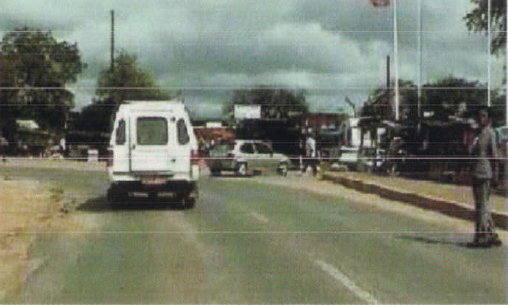
A. With a small vehicle driving in front of the Bakki. - Where must you wait?
Answer: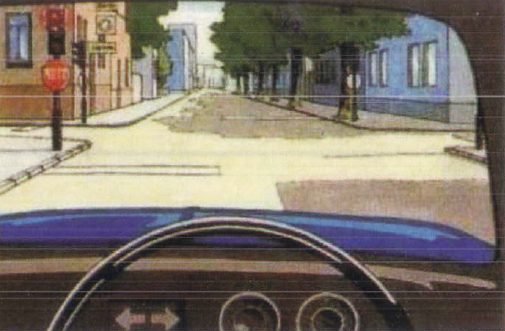
A. At the stop line. - At which places where there are no traffic signs regulating priority does the rule "right before left" apply?
Answer:
A. At crossroads and junctions. - You are approaching a crossroads where the priority situation is not clear to you straightaway. What do you do?
Answer:
A. Wait, observe and come to an agreement with others, if necessary. - You want to cross a priority road. The sight to both sides is greatly impaired by parking vehicles. What do you do?
Answer:
A. Drive onto the crossroads slowly and carefully. - Which conduct is correct?
Answer: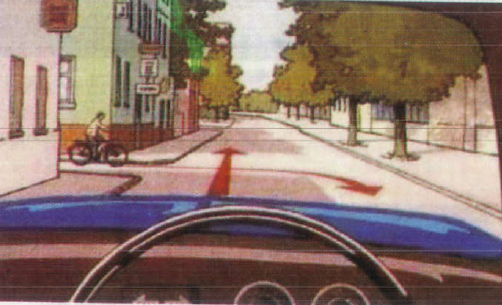
A. I may continue
B. The cyclist must wait. - Which conduct is correct?
Answer:
A. I must allow the cyclist to pass
B. The motorcyclist must wait for me. - Which conduct is correct?
Answer: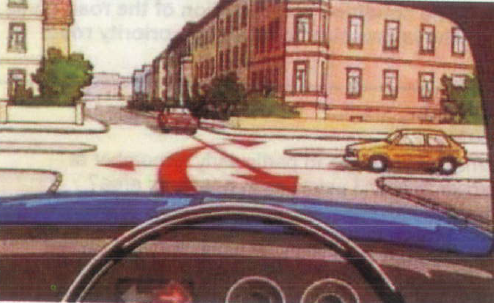
A. The red and yellow car proceed first. - Which conduct is correct?
Answer:
A. I allow the red car to proceed
B. I may pass in front of the green car. - Which conduct is correct?
Answer:
A. I allow the truck to proceed
B. The yellow car must wait. - Which conduct is correct?
Answer:
A. The cyclist must wait
B. I may pass in front of the motorcycle. - Which conduct is correct?
Answer:
A. I must allow the cyclist to turn
B. The blue car must wait. - Which conduct is correct?
Answer:
A. The blue car on the left must wait
B. The motorcyclist must wait. - Which conduct is correct?
Answer:
A. I am not allowed to cross the crossroads first
B. The red truck may proceed after the cyclist. - Which conduct is correct?
Answer:
A. I must wait. - Which conduct is correct?
Answer:
A. I am allowed to turn in front of the two other cars. - Which conduct is correct?
Answer:
A. I must allow the blue truck to proceed
B. I must allow the tractor to turn. - Which conduct is correct?
Answer:
A. I must allow the motorcycle to proceed
B. I proceed in front of the bus. - Which conduct is correct?
Answer:
A. I must allow the motorcycle to pass
B. I pass in front of the bus. - Which conduct is correct?
Answer:
A. I must allow the tram to proceed
B. I must allow the motorcycle to proceed. - Which conduct is correct?
Answer:
A. I must allow the motorcycle to turn in front of me. - Which conduct is correct?
Answer:
A. I may proceed first. - Which conduct is correct?
Answer:
A. I may only turn after the motorcycle
B. I may turn in front of the yellow car. - Which conduct is correct?
Answer:
A. I must allow the tram to pass. - Which conduct is correct?
Answer:
A. I must allow the cyclist to proceed
B. I must allow the buss to proceed C. I must first stop at the stop line. - Which conduct is correct?
Answer:
A. I must wait. - Which conduct is correct?
Answer:
A. I must wait. - Which conduct is correct?
Answer:
A. I must wait. - Which conduct is correct?
Answer: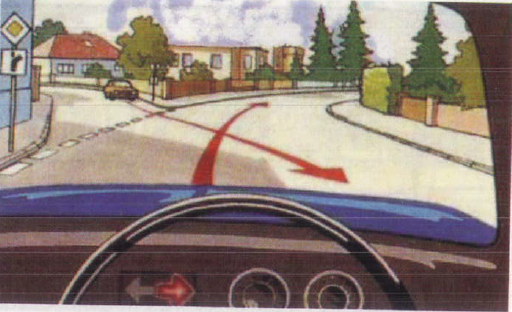
A. I may proceed. - Which conduct is correct?
Answer:
A. I must allow the motorcycle to pass. - Which conduct is correct?
Answer:
A. I may proceed first. - Which conduct is correct?
Answer:
A. I must allow the motorcycle to proceed
B. I must allow the blue car to proceed. - Which conduct is correct?
Answer:
A. I must allow the red car to pass
B. I may turn in front of the blue truck. - Which conduct is correct?
Answer:
A. I must allow the yellow truck to pass
B. I may turn in front of the green car. - Which conduct is correct?
Answer:
A. I may proceed. - Who must wait?
Answer:
A. The car coming from the farm track. - You want to turn left from this farm track. Who must wait?
Answer:
A. I must wait. - Which conduct is correct?
Answer:
A. I may proceed. - Which conduct is correct?
Answer:
A. I must allow the yellow car to pass. - Which conduct is correct?
Answer:
A. I must allow the blue car to pass
B. I may proceed in front of the motorcycle. - Which conduct is correct?
Answer:
A. I must give way to the blue car coming from the right
B. I have priority over the red car. - Which conduct is correct?
Answer:
A. I must allow the cyclist to pass
B. The green car proceeds after the cyclist. - Which conduct is correct at a 3-way-stop?
Answer:
A. At any junction where all roads have a STOP sign, the driver of every vehicle shall stop
B. The stopped vehicle which arrived first shall have priority to move off first, provided that it is safe to do so. - Which conduct is correct?
Answer:
A. I must allow the cyclist to proceed
B. I must wait for the blue truck. - Which conduct is correct?
Answer:
A. I proceed first. - Which conduct is correct at a 4-way-stop?
Answer:
A. At crossings where all roads have a STOP sign, the driver shall stop
B. The stopped vehicle which arrived first shall have priority to move off first, provided that it is safe to do so.
Traffic Control Through Lights
- What applies here?
Answer:
A. Vehicles turning left may turn off
B. Vehicles proceeding straight ahead and turning right must wait. - What is the correct procedure?
Answer:
A. The green car must wait
B. I may turn observing the traffic signs. - What do you do in this situation?
Answer:
A. Cross the crossroads without stopping. - The traffic lights are on flashing amber. What is the correct procedure?
Answer:
A. Approach with greater caution, giving way if necessary. - What must you do here?
Answer:
A. Turn right at a brisk pace. - What is permitted at these traffic lights with green arrow sign?
Answer:
A. Turn right from the right lane when there is no obstruction or danger to others. - When is it permitted to turn right at these traffic lights with green arrow sign?
Answer:
A. When there is no danger to other road users, particularly pedestrians and cross traffic
B. When there is no obstruction to other road users, particularly pedestrians and cross traffic. - Where should a vehicle stop at these traffic lights with green arrow sign intending to drive straight?
Answer:
A. At the stop line
B. Before the crossing or junction if there is no stop line. - What do these permanent control signs mean?
Answer:
A. I must switch from lane 2 to lane 1
B. I may not use lanes 3 and 4. - What do these signals indicate?
Answer:
A. The two lanes on the left are open to traffic
B. You may not use the two lanes on the right. - You are driving at a speed of approximately 40 km/h. The lights change from "green" to "amber" when you are 10 m away. What do you do?
Answer:
A. Proceed. - You are driving at a speed of approximately 40 km/h. The lights change from "green" to "amber" when you are 40 m away. What do you do?
Answer:
A. Stop. - You are approaching a traffic light which has been "green" for some time. What do you do?
Answer:
A. Watch the traffic light closely
B. Approach but be ready to stop. - The traffic light has just changed to "red". You intend to turn right. What do you do?
Answer:
A. Stop.
Traffic Control by Police Officers
- A police officer is regulating the traffic at the crossroads even though the traffic lights are in operation. What applies?
Answer:
A. The police officer's signals. - A police officer is regulating the trafic at a crossroads where there are also traffic signs governing priority. What applies?
Answer:
A. The police officer's signals. - How important are instructions from police officers?
Answer:
A. They must be obeyed. - What is correct?
Answer:
A. The yellow car must leave the crossroads B. I must get ready to proceed. - What is correct?
Answer:
A. Wait at the crossroads. - What is correct?
Answer:
A. Cross the crossroads at a brisk pace. - What applies here?
Answer:
A. The crossroads may be crossed.
Special Traffic Situations
- In which case are you not allowed to drive into the crossroads even though you have priority?
Answer:
A. If you would have to wait on the crossroads because of traffic congestion B. If you would obstruct a vehicle with flashing blue light and siren. - In which cases are you not allowed to drive into the crossroads even though the traffic light is "green"?
Answer:
A. If you would have to wait on the crossroads because of traffic congestion B. If a police officer orders you to stop. - Which are the areas you must not drive into when there is traffic congestion?
Answer:
A. Crossroads B. Level crossing
C. Junctions
D. Pedestrians crossing. - What do you do if the white car does not stop?
Answer:
A. Reduce speed, waive your priority.
Evaluate Your Understanding & Knowledge on Traffic Management Protocols
Evaluating your understanding and knowledge after studying the driver's manual ensures you've grasped essential concepts, identifying areas for improvement and boosting your confidence before the official driving test.
Please Click open the Quiz
Self Assessment Quiz
Your Score:
Traffic Road Signs / Traffic Facilities / Level Crossing
Traffic Road Signs
Understanding traffic road signs is fundamental for safe driving, providing essential information about the road ahead, guiding driving behavior, and ensuring the safety of all road users. Here's a detailed exploration of key road signs and what they signify for new and beginner drivers.

Color and Shape: Pay attention to the color and shape of signs as they provide quick clues about their message. For example, red often means stop or prohibition, yellow indicates caution, and green relates to directional information.
Location: The placement of a sign can also give context. For instance, signs placed over lanes often apply only to those lanes.
Visibility: Keep your windshield clean and headlights on when necessary to ensure signs are always visible, especially at night or in bad weather.
Updates and Changes: Road signs can change due to construction, special events, or new laws. Stay alert for new signs or temporary changes in familiar routes.
Study and Review: Regularly review road signs and their meanings. Many driving manuals and online resources provide comprehensive lists and explanations.
Practice Tests: Take advantage of practice tests and driving simulations that focus on road sign recognition to test your knowledge.
Observation While Passenger: When not driving, observe and identify road signs from the passenger seat to reinforce learning.
Important Points to Remember
Practice and Familiarization
Understanding traffic road signs is not just about passing your driving test; it's about ensuring safety on the road for yourself and others. Familiarity with these signs and consistent adherence to their instructions are key to becoming a responsible and confident driver.
A Comprehensive Guide for New and Beginner Drivers
Danger Signs
-
What do you do when you see this traffic sign?

Answer:
A. Reduce Speed
B. Be ready to brake. -
What should you remember when you see this traffic sign?

Answer:
A. Braking distance is greater on downhill slopes than on level ground
B. The brakes may become less efficient with prolonged use. -
What should you remember when you see this traffic sign?

Answer:
A. Avoid stopping and parking because of the danger of falling rocks
B. There may be rocks on the roadway
C. Vehicles in front may brake suddenly. -
What do you do when you see this traffic sign?

Answer:
A. Give precedence to oncoming traffic
B. When there are two lanes in one direction, employ the zipper feed-in method. -
You see this traffic sign. What must you reckon with?

Answer:
A. Oncomming traffic
B. Dazzle from oncoming traffic at night. -
What does this traffic sign require of you?

Answer:
A. Greatest alertness
B. Readiness to brake
C. Reduction in speed. -
What must you reckon with when you see this traffic sign?

Answer:
A. Cyclists crossing the roadway. -
You pass this traffic sign while driving outside a built-up area. How far off is the hazard to be expected?

Answer:
A. Between 150 m and 250 m. -
What must you remember when you see these traffic signs?

Answer:
A. You must expect soft verges. -
What must you be prepared for when you pass these traffic signs?


Answer:
A. That this road may be used by domestic animals
B. That the roadway is heavily soiled. -
What does this traffic sign indicate?

Answer:
A. There is a sharp left bend ahead. -
What do you do when you see this traffic sign?

Answer:
A. Reduce your speed
B. Drive as far as possible over on the left-hand side. -
What do you have to expect after this trffic sign?

Answer:
A. A downhill slope 800 m in length. -
What do you do when you see this traffic sign?

Answer:
A. Change down gear, if necessary. -
What should you do when you approach this traffic sign?

Answer:
A. Reduce your speed. -
What dangers can arise if this traffic sign is ignored?

Answer:
A. The vehicle could go into a skid and endanger oncoming traffic
B. The vehicle could suffer a broken axle or spring fracture
C. The load could be damaged -
What is this traffic sign a warning of?

Answer:
A. Unexpected pedestrians from the left
B. Unexpected pedestrians from the right. -
What do you when you see this traffic sign?

Answer:
A. Reduce your speed, if necessary
B. Employ the zipper feed-in method. -
What must you do when you see this traffic sign?

Answer:
A. Avoid braking heavily
B. Avoid sudden movements of the steering wheel. -
What must you avoid at a danger point marked by this traffic sign?

Answer:
A. Accelerateing strongly
B. Making sudden movements with the steering wheel
C. Keeping a short distance to the car in front of you. -
What do you do when you see this traffic sign?

Answer:
A. Reduce your speed
B. Refrain from overtaking. -
What must you reckon with when you see these traffic signs?

Answer:
A. The roadway narrowing approximately 50 m ahead. -
What must you reckon with when you see this traffic sign?

Answer:
A. Traffic from road construction vehicles
B. Men at work on the roadway
C. Construction materials on the roadway. -
What must you expect when you see this traffic sign?

Answer:
A. Start of roadworks 100 m ahead. -
What must you reckon with when you see this traffic sign?
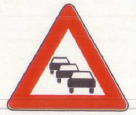
Answer:
A. Traffic congestion
B. The vehicles driving in front may suddenly brake. -
What do you do when you see this traffic sign?

Answer:
A. Check whether the bridge is passable
B. Stop if the bridge is swung open. -
What should you remember when you see this traffic sign?

Answer:
A. The road leads to a river bank
B. In darkness or poor visibility, the surface of the water could be mistaken for the roadway. -
What does this traffic sign indicate?

Answer:
A. Traffic lights. -
What does this traffic sign indicate?

Answer:
A. A pedestrian crossing. -
What must you reckon with when you see this traffic sign?

Answer:
A. A heavily soiled roadway
B. Farm animals on the roadway. -
What must you reckon with when you see this traffic sign?

Answer:
A. Sudden aeroplane noise
B. The attention of other road users may be diverted. -
What does this traffic sign indicate?

Answer:
A. A level crossing with barriers. -
What does this traffic sign indicate?

Answer:
A. A level crossing without barriers. -
What does this traffic sign indicate?

Answer:
A. A level crossing on the road turning right. -
What does this traffic sign indicate?

Answer:
A. A level crossing with barriers approximately 240 m ahead. -
What does this traffic sign indicate?

Answer:
A. A level crossing without barriers approximately 240 m ahead. -
What does this traffic sign indicate?

Answer:
A. A level crossing approximately 160 m ahead. -
What does this traffic sign indicate?

Answer:
A. A level crossing approximately 80 m ahead. -
What do you do when you see this traffic sign?

Answer:
A. Reduce speed when there is side wind
B. Be prepared to countersteer. -
What must you do when you see this traffic sign on Freeway?

Answer:
A. Increase your alertness and as a matter of precaution, increase your distance to the vehicle in front
B. In case of a traffic jam, brake and switch on hazard warning lights. -
What must you do when you see this traffic sign?

Answer:
A. Reduce speed before the bend
B. Drive as far as possible over the left-hand side. -
What do you do within this danger section?

Answer:
A. Drive more slowly, watch out for game animals
B. Dip the headlights and brake when you see game animals
C. Do not avoid hitting game animals if oncoming traffic would be endangered.
Mandatory Signs
-
When must you wait at this traffic sign?

Answer:
A. When a railway employee is waving a white-red-white flag
B. When the level crossing cannot be crossed without having to stop on it
C. When a rail vehicle is approaching. -
What do you do when you see this traffic sign?

Answer:
A. Approach cautiously at moderate speed
B. Give way. -
What must you do at this traffic sign?

Answer:
A. Stop at the stopline and, if necessary, stop again at a point where you can see along the interseecting road (line of sight) and give way
B. When there is no stop line, stop again at a point where you can see along the intersecting road (sight line). -
What do you do when you see this traffic sign?

Answer:
A. You must indicate left
B. You may only proceed to the left. -
What do you do when you see this traffic sign?

Answer:
A. You must indicate left
B. You may only proceed to the left. -
In which directions may you proceed?

Answer:
A. Straight ahead
B. To the right. -
What must you do when see this traffic sign?

Answer:
A. You must pass on the right of traffic islands. -
You are approaching a bus stop marked like this. What do you do if you see children there?

Answer:
A. Reduce your speed and be ready to brake. -
What does this traffic sign indicate?

Answer:
A. A special path for pedestrians
B. Cycles and mopeds prohibited -
What must you remember when you see this traffic sign?

Answer:
A. You may not drive a motor vehicle in this pedestrian precinct. -
Which vehicles are not allowed to use this road?

Answer:
A. Motor vehicles of any kind. -
Which vehicles are not allowed to drive here?

Answer:
A. Mopeds. -
What must you remember when you see this traffic sign?

Answer:
A. Vehicles may come out of this road
B. You may not enter this road -
What must you remember when you see this traffic sign?

Answer:
A. You may not stop. -
What is allowed at this traffic sign?

Answer:
A. Stopping for loading or unloading, for alighting or boarding vehicles
B. Waiting up to 3 minutes. -
What is permitted when you see these traffic signs?

Answer:
A. Severely disabled persons with the appropriate numbered parking permit may park here
B. Anyone is allowed to stop to pick up or drop passengers -
What do these traffic signs tell you?

Answer:
A. There is a "STOP" sign 100 m ahead. -
What do you do when you see this traffic sign?

Answer:
A. You must give precedence to oncoming traffic. -
What do you do when you see this traffic sign?

Answer:
A. You must indicate left
B. You may only proceed to the left. -
What do you do when you see this traffic sign?

Answer:
A. You must indicate right
B. You may only proceed to the right. -
What does this traffic sign indicate?

Answer:
A. You may only proceed straight ahead. -
In which directions are you allowed to continue?

Answer:
A. To the left
B. To the right. -
What do you do when you see this traffic sign?

Answer:
A. You must pass obstacles on the left. -
What do you do when you see this traffic sign?

Answer:
A. You may stop
B. You must not endanger passengers boarding or alighting. -
A school bus is stopping along the roadway approximately 80 m in front of you. Can this be dangerous?

Answer:
A. Yes, because children frequently run across the road to catch the bus
B. Yes, because children do not always take the shortest route to cross the roadway. -
What should you remember when you see this traffic sign?

Answer:
A. You must reckon with taxis pulling in and setting off. -
What does this traffic sign indicate?

Answer:
A. A cycle track. -
What does this traffic sign indicate?

Answer:
A. A track prohibited for road users other than horse riders
B. A track which horse riders are required to use. -
What must a motorist do on this road?

Answer:
A. Drive at walking speed only
B. Pay particular attention to pedestrians. -
Who is allowed to drive a motor vehicle on this road?

Answer:
A. Persons delivering goods. -
Which vehicles are allowed to use the special lane marked like this?

Answer:
A. Regular buses. -
Who is allowed to enter a street sign posted like this?

Answer:
A. Residents
B. People visiting residents. -
Who is allowed to enter a street sign posted like this?

Answer:
A. If necessary, drive at walking speed
B. Watch out for walking people. -
Which vehicles are not allowed to use a road sign posted like this?

Answer:
A. Trucks
B. Cars. -
Which vehicles are not allowed to use a road sign posted like this?

Answer:
A. Bicycles. -
Which vehicles are not allowed to use a road sign posted like this?

Answer:
A. Motorcycles. -
What do these traffic signs indicate?

Answer:
A. No entry 100 m ahead. -
Which vehicles may proceed here?

Answer:
A. Cars with "SMOG label"
B. Vehicles with electric drive. -
What does this traffic sign indicate?

Answer:
A. No turning. -
What does this traffic sign indicate?

Answer:
A. You must not drive faster than 60 km/h. -
What does this traffic sign indicate?

Answer:
A. The start of a zone with a permitted maximum speed of 30 km/h. -
A traffic calmed commercial zone starts here. What must you do?

Answer:
A. You must specifically watch out for busy pedestrian traffic
B. You must pay attention to the allowed maximum parking time. -
What does this traffic sign indicate?

Answer:
A. The end of a zone with a permitted maximum speed of 30 km/h. -
Are you allowed to drive at a speed faster than 60 km/h here?

Answer:
A. Yes if the roadway is dry. -
What do youd when you see this traffic sign?

Answer:
A. You must drive at least at a speed of 60 km/h, weather and traffic conditions permitting
B. You may not use this road if you cannot or are not allowed to drive at least 60 km/h. -
Which vehicles are you allowed to overtake where you see this traffic sign?

Answer:
A. Motorcycle without sidecar. -
What do these traffic signs indicate?

Answer:
A. No overtaking for 3 km. -
What do these traffic signs indicate?

Answer:
A. Start of a no-overtaking area 200 m ahead. -
What does this traffic sign indicate?

Answer:
A. End of speed restriction. -
Which prohibitions are ended by these traffic signs?

Answer:
A. No overtaking
B. Speed restrictions. -
What do these traffic signs indicate?
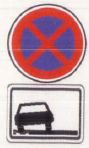
Answer:
A. No stopping on the roadway and the hard shoulder. -
What is allowed in the zone which starts here?

Answer:
A. Waiting for up to 3 minutes
B. Waiting for loading or unloading as well as boarding or alighting. -
What ends here?

Answer:
A. A no-waiting area. -
What should you remenmber when you see a line like this in the centre of the roadway?

Answer:
A. You may not cross or straddle the line. -
What should you remember here (not a priority road)?

Answer:
A. Parking is permitted if a gap of at least 3 m is left between a parked vehicle and the center line
B. Vehicles may not cross or straddle the center line. -
You want to overtake. What do you do?

Answer:
A. You may cross both lines provided no-one is endangered thereby. -
What must you remember when you see this traffic sign?

Answer:
A. Minimum speed of 60 km/h. -
Which traffic sign refers to the permissible total mass?

Answer:
A. (( 2 )). -
Which traffic sign refers to the actual mass?

Answer:
A. (( 1 )). -
Which vehicles are prohibited from using a road sign posted like this?

Answer:
A. Vehicles with an actual axle weight exceeding 2 t. -
What does this traffic sign indicate?

Answer:
A. A prohibition for vehicles more than 2 m wide including load. -
Which vehicles can cause serious accidents when this traffic sign is ignored?

Answer:
A. Vehicles of the following dimensions, including load: Length 8 m, width 2.5 m, height 4 m. -
With which vehicles are you not allowed to drive on a road sign posted like this?

Answer:
A. Car with caravan trailer, total length of the combination 11 m
B. Tractor with trailer, total length of the combination 12 m.
Advisory Signs
-
When does this traffic sign indicate?

Answer:
A. Priority only at the next crossroads or junction. -
What does this traffic sign mean?

Answer:
A. You are on priority road
A. Priority road gives right of WAY. -
What should you remember when you approach these traffic signs?

Answer:
A. You will remain on the priority road if you turn left. -
What applies after this traffic sign?

Answer:
A. You must not drive faster than walking speed
A. You must look out for children playing. -
What does this traffic sign indicate?

Answer:
A. The start of a HIGHWAY. -
What does this traffic sign indicate?

Answer:
A. One-way street. -
What must you expect when you see this traffic sign?

Answer:
A. Flowing traffic wil be stopped in order to let children cross the road
A. Children will run across the roadway more often than usual. -
Which traffic sign gives right of way at the next crossroads?

Answer:
A. Traffic sign (( 1 )). -
What traffic sign gives right of way?

Answer:
A. Traffic sign (( 2 )). -
What does this traffic sign tell you?

Answer:
A. Priority road
B. No parking outside built up areas -
What is allowed on priority roads outside built-up areas?

Answer:
A. Stopping on the left edge of the roadway
B. Parking on the hard shoulder. -
What must you remember when you see this traffic sign?

Answer:
A. If you follow the priority road, you must indicate left
B. If you follow the priority road, you must show consideration to pedestrians and wait, if necessary. -
What ends here?

Answer:
A. A priority road. -
What do you do when you see this traffic sign?

Answer:
A. You may only take precedence when the narrowing is clear
B. You must be ready to stop despite taking precedence. -
What does this traffic sign indicate?

Answer:
A. If you follow the priority road, you must indicate right -
What does these traffic signs allow?

Answer:
A. Residents holding a parking licence with corresponding number may park here. -
Who may park here?
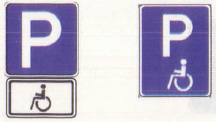
Answer:
A. A car for a seriously disabled person with a special walking disability. -
What must you observe when parking here?

Answer:
A. The parking time indicated on the parking ticket may not be exceeded
B. The parking ticket must be put in a place so it can be easily read when controlled. -
Which vehicles are allowed to park here?

Answer:
A. Vehicles with a permissible total mass of up to 2.8 t
B. Motorcycles. -
What does this traffic sign indicate?

Answer:
A. A parking space connected to local public transport. -
What must you reckon with when you see this traffic sign?

Answer:
A. Hikers who have parked their car here temporarily. -
What does this traffic sign indicate?

Answer:
A. The end of a traffic calmed area. -
What must a motor vehicle's maximum speed, determined by its construction, be at least if you want to use this road?

Answer:
A. (( 61 )) km/h. -
In which cases are you allowed to cross the line in the centre of the roadway?

Answer:
A. To avoid an obstruction
B. To overtake. -
Pedestrians wish to cross the road. What do you do?

Answer:
A. Approach the pedestrian crossing at moderate speed and, if necessary, wait
B. Do not overtake at a pedestrian crossing. -
What does this traffic sign indicate?

Answer:
A. A cul-de-sac(ending) road. -
What does this traffic sign indicate?

Answer:
A. A first aid station. -
What does this traffic sign indicate?

Answer:
A. A breakdown service. -
What does this traffic sign mean?

Answer:
A. The shoulder beside the roadway is not hard enough. -
What does this traffic sign mean?

Answer:
A. The shoulder on the side of the roadway is not hard enough for vehicles with a permissible total mass of more than 3.5 t
B. A warning that tractors should not use the hard shoulder. -
What does this traffic sign indicate?

Answer:
A. A customs post. -
What must you remember when you see this traffic sign?

Answer:
A. It indicates to the driver that there is a park-and-ride terminus. -
What does this traffic sign indicate?

Answer:
A. Coordinated robots at the average speed of 55 km/h. -
What does this traffic sign indicate?

Answer:
A. A numbered diversion. -
What does this traffic sign indicate?

Answer:
A. A Highway section which is normally not used very much. -
What does this traffic sign indicate?

Answer:
A. The end of a dual carriageway. -
What does this traffic sign indicate?

Answer:
A. The end of the clearway for motor vehicles only. -
What does this traffic sign indicate?

Answer:
A. It recommends not driving faster than 80 km/h even under good conditions. -
What does this traffic sign indicate?

Answer:
A. The number of a dual carriageway. -
What does the figure "A 1" indicate in this traffic sign?

Answer:
A. Dual carriageway number "A 1" leads to Francistown. -
What does this traffic sign indicate?

Answer:
A. A diversion for Highway traffic when required. -
What applies from this traffic sign onwards?

Answer:
A. Maximum permissible speed 60 km/h
B. Free choice of driving lane for motor vehicles with a permissible total mass up to 3.5 t. -
What applies from this traffic sign onwards?

Answer:
A. You may not sound your horn to signal your intention to overtake
B. Parking cars may be safely marked with parking light. -
How are vehicles with a permissible total mass up to 2.8 t allowed to be parked here?

Answer:
A. The car as shown in the picture.
Traffic Facilities
-
What can red-white warning plates on vehicles indicate?
Answer:
A. A trailer parked on the roadway within a built-up area
B. A vehicle with excessive width. -
You approach this traffic control facility on the Freeway. What do you do?

Answer:
A. Change into the left lane, if necessary, using the zipper feed-in method. -
You need assistance on the Freeway. Which information does the arrow in the roadside marker give you?

Answer:
A. Nearest emergency call telephone in the direction of the arrow.
Level Crossings
-
A railway employee is waving a white-red-white flag at a level crossing. What does this mean?
Answer:
A. You must wait in front of the level crossing. -
When must you wait at a level crossing?
Answer:
A. When a flashing red light comes on
B. When the barriers are being lowered
C. When a railway employee is waving a white-red-white flag. -
You are approaching a level crossing with half barriers and flashing lights. The red light is flashing but the barrier is still open. What do you do?
Answer:
A. Wait in front of the level crossing. -
A railway employee is waving a red lamp at a level crossing. What does this mean?
Answer:
A. You must wait in front of the level crossing. -
You are approaching a level crossing where the barriers are open. What do you do?
Answer:
A. Approach at moderate speed, look along the railway line
B. Wait in front of the level crossing if you would have to wait on it because of traffic congestion. -
At the entrance to an industrial estate, there is a level cross with the supplementary sign "Industrial Estate, rail vehicles have precedence". What must you remember?
Answer:
A. Approach level crossings at moderate speed only
B. Rail vehicles have precedence at all level crossings. -
You are driving along a forest track and approach a level crossing without a level cross sign. What do you do?
Answer:
A. Proceed at moderate speed and check to see if a rail vehicle is approaching
B. Listen out in case a rail vehicle signals approach by whistling or ringing a bell. -
What do you do a level crossing when the barriers are closed?
Answer:
A. Wait before the level cross sign without obstruting junctions
B. If possible, switch on the parking lights when it is dark. -
What is the meaning of level cross with a flashing red light in the form of an arrow pointing to the right?
Answer:
A. Road users wishing to turn right must wait
B. RThe flashing light does not concern road users driving straight ahead. -
When are you allowed to cross a level crossing with flashing lights but no barriers after a train has passed?
Answer:
A. When the flashing red light goes out. -
You are approaching a level crossing with barriers. Where must you wait if you would have to stop on the rails in case of traffic congestion?
Answer:
A. In front of the railway cross. -
What do you do here?

Answer:
A. Approach at moderate speed and wait. -
When should you switch off the engine to save fuel and reduce pollution?
Answer:
A. When you have to wait in a traffic jam for a long time
B. When you have to wait at level crossings or building sites. -
How can you protect the environment and save petrol when waiting for a long time at closed level crossing barriers?
Answer:
A. By switching off the engine. -
While driving a car with a trailer outside a built-up area on a road where overtaking is prohibited, you approach a level crossing?. Where must you wait, when the barriers are closing
Answer:
A. Immediately after the single-stripe beacon. -
Which vehicle must wait immediately after the single-stripe beacon at level crossings (overtaking is not prohibited) outside built-up areas when the red light is flashing?
Answer:
A. A truck with a permissible total mass of exceeding 3.5 t
B. A truck tractor with trailer.
Evaluate Your Understanding & Knowledge on Traffic Road Signs / Facilities / Level Crossing
Evaluating your understanding and knowledge after studying the driver's manual ensures you've grasped essential concepts, identifying areas for improvement and boosting your confidence before the official driving test.
Please Click open the Quiz
Self Assessment Quiz
Your Score:
After the Driving Test & Getting your Driving License
Getting your Driver's License
Successfully passing your driving test and obtaining your license marks the beginning of a new journey on the road. It's a significant milestone that brings with it the responsibility to continuously apply the skills and knowledge you've acquired. Remember, learning doesn't stop once you have your license; it's an ongoing process. Stay informed about traffic laws, practice safe driving habits, and consider advanced driving courses to enhance your abilities. Your license is not just a permit to drive—it's a commitment to safety and responsibility.

Eligibility: Age requirements vary by jurisdiction but typically start at 15 or 16 years for a learner's permit. Understand the specific age, residency, and identification requirements in your area.
Learner's Permit: Often the first step, allowing you to practice driving under certain conditions (e.g., with an adult licensed driver). You usually need to pass a written knowledge test covering road signs, traffic laws, and safe driving practices.
Written Test Preparation: Study the driver's handbook provided by your local motor vehicle department. Many jurisdictions offer online practice tests to help you prepare.
Practical Driving Lessons: Enroll in a driving school if possible. Professional instruction can provide you with valuable skills and confidence. Practice driving regularly in various conditions and settings.
Road Test: Demonstrates your ability to operate a vehicle safely. Familiarize yourself with the test format, which often includes maneuvers like parallel parking, merging, turning, and navigating intersections.
Required Documents: Gather necessary documents early. These typically include proof of identity, residency, and possibly completion of a driver's education course.
Fees: Be prepared to pay fees for the learner's permit, road test, and license issuance. Fees vary by location.
Importance: While not always mandatory, driver's education courses are highly recommended. They cover driving theory, road safety, and practical skills, and may even reduce insurance premiums.
Options: Many schools offer both classroom and behind-the-wheel training. Online courses are also available for the theoretical part in some regions.
Vision Test: Almost all jurisdictions require a vision test to ensure you meet the minimum eyesight standards for driving.
Medical Conditions: Disclose any medical conditions that could affect your driving to the licensing authority. Some conditions may require a doctor's note confirming your fitness to drive.
Requirement: You must have insurance coverage to drive legally. As a new driver, you may be covered under a parent's policy or need to obtain your own.
Cost: Insurance rates for new drivers are typically higher due to the increased risk. Shop around for the best rates and consider vehicles that are cheaper to insure.
Laws and Regulations: Traffic laws can change. Stay informed about current rules, including restrictions on mobile phone use, seat belt laws, and speed limits.
Renewal and Maintenance: Understand the process for renewing your license and any ongoing education or testing requirements.
Commitment to Safety: Safe driving doesn't end with obtaining a license. Commit to continuous learning and practice, adhering to traffic laws, and adopting defensive driving techniques.
A Comprehensive Guide for New and Beginner Drivers
Obtaining a driver's license is a rite of passage for many, marking a significant step towards independence. The process involves understanding legal requirements, preparing for tests, and demonstrating driving competence. Here's what you need to know:
Understanding Licensing Requirements
Preparing for the Driving Tests
Documentation and Fees
Driver's Education
Health and Vision Tests
Insurance
Staying Informed
Safe Driving Practices
Important Notes !!!
Getting a driver's license involves careful preparation, understanding legal requirements, and a commitment to learning and practicing safe driving habits. Treat the process with the seriousness it deserves, recognizing that driving is a responsibility with significant safety implications for yourself and others on the road.
Learner Driver
-
Young drivers travelling to and from discotheques at night are often involved in serious accidents. What could be important reasons for this?
Answer:
A. Exuberance, high spirits and carelessness
B. Driving too fast and taking risks in the order to show off. -
The risk of young drivers being involved in an accident is much higher than that of older drivers. What could be important reasons for this?
Answer:
A. Many young drivers want to test themselves and the performance of their cars. By doing this, many of them are involved in situations they cannot master.
B. Many young drivers take too many risks and are too thoughtless when driving. They often lack experience in order to assess the risks
C. Many young drivers rely too much on the safety of their vehicles. -
Driving at night to the next discotheque by car, a group of young men and women wants to keep spirits high during the journey. They thus sing exuberantly, laugh and turn up the volume on the car radio. How should the driver of the car react in such a situation?
Answer:
A. The driver responsible for safety must distance himself from the group in such a case and ask his passengers not to divert his attention. -
What are frequent causes of traffic accidents after a visit to the discotheque?
Answer:
A. YInexperienced young drivers, particularly when driving in the dark
B. Young drivers showing off when travelling in groups
C. Young drivers lacking experience in driving fully loaded cars.
Driving License on Probation
-
What can result in your qualification to drive being reviewed?
Answer:
A. Frequent violation of traffic regulations
B. Permanent physical handicaps which may put the safe driving of motor vehicles into question. -
What is the current trial (learner) period?
Answer:
A. (( 6 )) months. -
An applicant for a learner permit is caught driving without a licence during this training period. Can this be a reason not to issue a driving licence to him?
Answer:
A. Yes, because this creates doubts about his characters.

Evaluate Your Understanding & Knowledge on Getting your Driving License
Evaluating your understanding and knowledge after studying the driver's manual ensures you've grasped essential concepts, identifying areas for improvement and boosting your confidence before the official driving test.
Please Click open the Quiz
Self Assessment Quiz
Your Score:
Different Road Users and Driving Manoeuvre's
Different Road Users and Driving Manoeuvre's
Different road users, including motorists, cyclists, and pedestrians, require a comprehensive understanding and execution of driving maneuvers to coexist safely. Each maneuver, whether it's changing lanes, turning, or navigating intersections, must consider the diverse needs and vulnerabilities of all users. This approach promotes inclusivity and safety, ensuring that roads accommodate everyone from the most agile cyclists to the most cautious pedestrians. By practicing awareness and respect for all, drivers contribute to a safer, more harmonious roadway environment.

Different Road Users / Traffic Calming Measures
-
What must you recon with in residential areas with little traffic?
Answer:
A. Children at play often run onto the roadway
B. Pedestrians and cyclists are frequently inattentive. -
A ball rolls out into the roadway in front of your vehicle in a residential area. How should you react?
Answer:
A. Reduce speed at once and remain ready to brake
B. Stop if children run onto the roadway. -
You are approaching children playing on the pavement. What should you do?
Answer:
A. Reduce speed at once and remain ready to brake. -
What should you reckon with when approaching children?
Answer:
A. Rash behaviour on the part of the children. -
What must you reckon with?
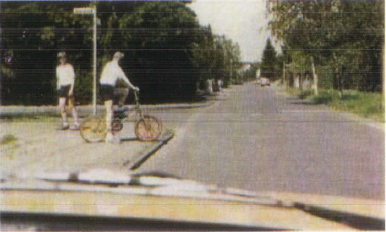
Answer:
A. The boy could set off at any moment
B. The boy might look right but still set off. -
What must you do?

Answer:
A. You must keep a close eye on the children and proceed cautiously. -
What must you be prepare for?

Answer:
A. The boy ahead of you could turn right to follow the other child
B. The boy ahead of you could turn right without signalling a change of direction. -
What must you do?

Answer:
A. Brake heavily immediately and remain ready to brake. -
What must you be prepared for?

Answer:
A. One of the children could turn back to collect the ball
B. The girl could turn back and run to the other children. -
What do you have to do?

Answer:
A. Reduce speed, remain ready to brake and drive cautiously past. -
What do you have to do?

Answer:
A. Brake immediately and remain ready to brake. -
What do you have to do?

Answer:
A. Brake and, if necessary, stop. -
What must you reckon with when elderly people are crossing the roadway?
Answer:
A. They do not always pay attention to vehicle traffic
B. They often stop abruptly on the roadway
C. They often turn back in the middle of the roadway. -
A pedestrian with a white stick wants to cross the roadway in front of you. What do you have to do?
Answer:
A. Reduce speed and, if necessary, stop. -
What must you reckon with?

Answer:
A. People crossing the street in front of the bus
B. People running across the street from the left to catch the bus. -
The bus has come to a halt at the stop. Under which conditions are you allowed to pass at walking speed?

Answer:
A. If danger for passengers boarding and alighting is excluded
B. If passengers boarding and alighting are not obstructed. -
What must you reckon with when children are waiting at traffic lights?
Answer:
A. The children will start running when their lights change from green to amber
B. The children also start running when the light is red because they cannot wait
C. The children will push each other into the roadway. -
A group of children is cycling on a cycle track. What must you heed in general?
Answer:
A. The children will move onto the roadway without paying attention
B. The children will move too far onto the roadway. -
Which statements are correct? (Brake lights ON)

Answer:
A. You may pass on the right-hand side at walking speed provided that passengers are not impeded and you are sure no-one is endangered. -
Which vehicles may pass here at walking speed only, provided that passengers are not endangered in any way?

Answer:
A. All vehicles travelling in the same direction
B. All vehicles travelling in the opposite direction. -
What must you heed in this situation?

Answer:
A. You may pass the stationary bus at walking speed provided you are sure that passengers are not endangered. -
Why are elderly pedestrians more at risk in traffic than younger people?
Answer:
A. Their eyesight and hearing are often poorer
B. Their reactions are slower and they are less agile
C. Theycannot always judge the speed of vehicles accurately. -
You want to turn left. What must you be prepared for?

Answer:
A. The truck will stop
B. The pedestrian might let the truck pass then cross the roadway in front of you
C. After the truck has turned, the pedestrians may come from the opposite side. -
What must you remember at thes bus stops?

Answer:
A. Pedestrians sometimes step off the roadway without paying attention
B. Pedestrians often run across the roadway in order to catch the bus.. -
What must you do?
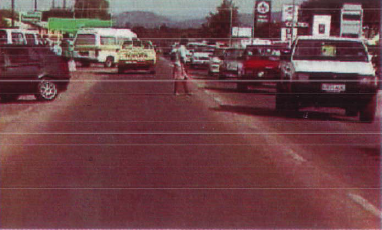
Answer:
A. Brake and, if possible, pass slowly on the left
B. Keep sufficient lateral distance to the pedestrian. -
A child is walking on the pavement with a dog on a lead. Can this cause a dangerous situation?
Answer:
A. Yes, if the dog suddenly runs onto the roadway and pulls the child along behind
B. Yes, if the dog tears away and the child runs after the dog. -
What must you heed in this situation?

Answer:
A. You may pass at walking speed only
B. You may pass only if you are sure that pedestrians are not endangered. -
Which statements are correct in this situation?

Answer:
A. Cars coming from the opposite direction may pass the bus provided that they do so with care
B. You may pass the bus provided that you do so with care. -
Which statements are correct in this situation? (Hazard warning lights ON)

Answer:
A. The bus may be passed in either lane but no faster than at walking speed
B. Vehicles in both lanes must stop if passengers would otherwise be endangered. -
What must you be prepared for when a truck in front of you wishes to turn right into a narrow street?
Answer:
A. The truck will reduce speed drastically
B. The truck will swing out to the left before turning. -
What must you be prepared for in this situation?

Answer:
A. The sudden appearance of oncoming traffic
B. The bus driver suddenly jumping to the left side
C. Oncoming traffic concealed by the bus. -
When can a cyclist represent a danger for you?

Answer:
A. When the cyclist switches to the roadway without paying attention to the traffic. -
You are approaching a school. Children are leaving the school grounds. What must you reckon with?
Answer:
A. The children rush onto the road without thinking
B. That children ride their bicycles onto the road without paying attention. -
What must you reckon with?

Answer:
A. The moped rider could pull out to the right to overtake the cyclist
B. The driver of the van could step onto the road while unloading
C. Pedestrians crossing the road in front of the van -
What must you be prepared for in this situation?

Answer:
A. That the braking distance will be longer
B. That the driver could suddenly steer into your lane. -
Why are motorcyclists particularly at risk?
Answer:
A. Because they are easily overlooked
B. Because their speed is often underestimated
C. Because they are exposed to greater risk of injury in accidents. -
At a bus stop, passengers are getting on and off the bus onto the roadway. What do you doif you want to drive past on the left?
Answer:
A. Wait if passengers can be endangered or inconvenienced
B. Drive cautiously at walking speed past if this is possible without endangering or inconveniencing passengers. -
What must you observe when driving past a bus which has stopped at a bus stop?
Answer:
A. Keep a sufficient distance from the bus and drive past cautiously, since pedestrians might suddenly cross the roadway in front of the bus. -
What do you do when a bus has stopped at a bus stop with its hazard warning lights switched on?
Answer:
A. Drive past at walking speed only and, if necessary, stop
B. Drive past at a sufficient distance in order to exclude endangering pedestrians
C. Wait if passengers could be inconvenienced. -
Which vehicles must you allow to set off from marked bus stops?
Answer:
A. Regular buses
B. School buses. -
A regular bus in the oncoming traffic has stopped at a bus stop on the same road roadway with hazard warning lights switched on. What do you do?
Answer:
A. Slow down to walking speed. -
A bus is driving in the middle of the roadway and reaches a bus stop where passengers are waiting at the edge of the roadway. What do you do shortly before the bus comes to a stop?
Answer:
A. I remain behind the bus in order not to endanger the passengers. -
You are approaching a regular bus, which has stopped in the opposite direction at a bus stop on your roadway and its hazard warning lights are switched on. What must you expect?
Answer:
A. Passengers will cross the roadway in order to catch the bus
B. Passengers leaving the bus will suddenly cross the roadway.
Behaviour at Pedestrian Crossings and Subways
-
What conduct must you expect of children at zebra-crossings?
Answer:
A. They will run onto the zebra crossing without paying attention to traffic
B. They will turn around on the zebra crossing for no apparent reason and run back. -
How are elderly pedestrians often expected to behave at zebra crossings?
Answer:
A. They look neither right nor left
B. They step unexpectedly onto the roadway
C. They sometimes turn back in the middle of the roadway. -
What must you do?

Answer:
A. Brake early in order to show the pedestrians that they may pass. -
What must you do here?

Answer:
A. Stop to allow the pedestrians to cross the roadway. -
In which cases must you approach the zebra crossing with particular care?
Answer:
A. When pedestrians want to cross the roadway
B. When the view of the zebra crossing is obstructed
C. When another vehicle is already waiting at the zebra crossing. -
What applies immediately before and on zebra crossings?
Answer:
A. You may not overtake
B. You may not stop. -
A cyclist wrongly crosses the zebra crossings without getting off his bicycle. What is correct?
Answer:
A. Give in and let the cyclist cross the roadway. -
What doyou do in this situation?

Answer:
A. I let the pedestrian cross the roadway
B. I wait at the zebra crossing until the van has turned off. -
A pedestrian want to cross the roadway on a zebra crossing. What do you do?
Answer:
A. Approach at moderate speed and wait if necessary
B. Do not overtake under any circumstances. -
A truck stops in the left lane on a zebra crossing. You are driving in the right lane. What do you do?
Answer:
A. Wait because pedestrians might cross the roadway. -
You are in congested traffic and must wait. There is a pedestrian crossing in front of you. What do you do?
Answer:
A. Leave the crossing free. -
There is mud on a pedestrian crossing and only the sign "Pedestrian Crossing is visible. A pedestrian wants to cross the roadway. What do you do"?
Answer:
A. Cautiously brake in good time
B. Stop if necessary so that the pedestrian can cross the roadway. -
Why is it particularly important to brake in good time when approaching a zebra crossing?
Answer:
A. So that pedestrians are not scared or made insecure
B. To avoid front-end collision. -
You coming to a stop unexpectedly on a pedestrian crossing. What do you do?
Answer:
A. Move slightly forward or backward in order to clear the crossing as quickly as possible. -
Roundabout situation?


Evaluate Your Understanding & Knowledge on Different Road Users and Driving Manoeuvre's
Evaluating your understanding and knowledge after studying the driver's manual ensures you've grasped essential concepts, identifying areas for improvement and boosting your confidence before the official driving test.
Please Click open the Quiz
Self Assessment Quiz
Your Score:
Vehicle Parking, Entry, Security, and Towing Procedures
Vehicle Parking, Accessibility, and Towing Procedures
Vehicle parking and entry procedures, alongside security, accessibility, and towing policies, form a comprehensive framework ensuring the orderly and safe use of parking facilities. Proper parking ensures vehicles do not obstruct traffic or access, while security measures protect against theft or vandalism. Accessibility is crucial, guaranteeing spaces for those with disabilities. Adhering to established towing procedures ensures that vehicles improperly parked or posing safety risks are promptly addressed. Together, these practices foster a secure, accessible, and efficient environment for all vehicle users.

Driving Manoeuvre
Driving in and Starting
-
You want to pull out of a row of parked vehicles into the stream of moving traffic. Behind you is a parked truck and trailer. How do you assess this situation?
Answer:
A. Because of your restricted view, you cannot see approaching vehicles until they are very close
B. Because of their restricted view, vehicles approaching from behind cannot see your vehicle until very late. -
You want to pull out of a driveway and turn left onto the road. A cyclist is approaching from the right. Who must wait?
Answer:
A. You must wait. -
You want to pull out of a driveway across the pavement onto the roadway. What must you look out for first?
Answer:
A. Children cycling on the pavement
B. Children playing and pedestrians. -
You want to pull out onto a road from a traffic calmed area. What must you do?
Answer:
A. Allow pedestrians on the pavement to pass
B. Give precedence to vehicles. -
You want to turn onto a road from a traffic calmed area. A cyclist is approaching from the right. Who must wait?
Answer:
A. You must wait. -
You want to turn out of a road with a sunken kerbstone into another road. A car is coming from the right. Who must wait?
Answer:
A. Whoever turns into a road over a sunken kerbstone must wait. -
What must you do when leaving the edge of the roadway?
Answer:
A. Check for traffic from behind
B. Switch on your direction indicator. -
You want to set off from the driveway. Who must wait?

Answer:
A. You must wait.
Driving Alongside Other Vehicles
-
By mistake, you have taken the right-hand lane but wish to turn left. What do you do?

Answer:
A. Proceed straight ahead or turn right. -
What must you remember when you want to change lanes?
Answer:
A. You must signal your intention to change lanes in time
B. You must pay attention to the traffic following behind. -
Where must the zipper feed-in method be employed?
Answer:
A. Where a lane comes to an end
B. Where a lane is entirely blocked by an obstruction. -
On a roadway with several lanes in one direction, one lane comes to an end. What must the drivers in the continuing lane do?
Answer:
A. Allow the vehicles which are unable to proceed to move into the continuing lane using the zipper feed-in method. -
You want to proceed straight ahead. What do you do?

Answer:
A. Reduce speed, keep your distance and, if fnecessary, stop
B. If there is a large enough gap in the traffic, change to the right-hand lane. -
You have taken the left lane by mistake although you want to turn right. How are you allowed to proceed?

Answer:
A. Straight ahead
B. To the left. -
What do you do if you want to drive straight on?

Answer:
A. Brake so that the driver in front can change lanes. -
A car is reversing into a parking space. The vehicle travelling in front of you is moving into the right-hand lane. What should you do?

Answer:
A. If traffic behind permits, move into the right-hand lane too
B. If vehicles behind you are overtaking, stay in the left hand lane, drive slowly and, if necessary stop. -
You are approaching the vehicles in this picture. What do you do?

Answer:
A. Watch if the truck and trailer remainon the hard shoulder
B. Allow the truck and trailer to enter the roadway when it indicates right. -
What must you know about using the rear-view mirror?
Answer:
A. You cannot see vehicles and pedestrians in a blind angle
B. Rear-view mirrors must be adjusted to the driver. -
What must you reckon with here?

Answer:
A. The vehicle in front changing lanes
B. Denser traffic beyond the underpass. -
You are approching the truck and trailer which is changing into your lane at about 60km/h. Which possibilities do you have?

Answer:
A. Keep in lane and let the truck and trailer filter in
B. Keeping a careful eye on vehicles travelling behind, switch to the right-hand lane.
Passing
-
What do you do in this situation?

Answer:
A. Stop, if you cannot pass without danger. -
Which vehicle must wait when half the roadway is closed because of roadworks?
Answer:
A. The vehicle on the side of the roadway where the roadworks are. -
Who must wait?

Answer:
A. I must wait. -
What do you do?

Answer:
A. Reduce speed and, if necessary, stop.
Overtaking
-
There are cyclists and pedestrians on the roadway. What must you remember when overtaking?
Answer:
A. You may only overtake keeping a safe lateral distance (at least 1.5 m)
B. You may only overtake if oncoming traffic makes it impossible to sufficient lateral distance. -
Is it irresponsible to overtake a truck and trailer before a crossroads?
Answer:
A. Yes, because the truck and trailer can obscure the view of important traffic signs
B. Yes, because the truck and trailer can obscure the view of the crossing traffic. -
You want to overtake a cyclist. Is a lateral distance of 50 cm enough for overtaking?
Answer:
A. No, because the cyclist might suddenly swing out. -
When can overtaking be dangerous even on clear straight roads?
Answer:
A. Because the speed of oncoming traffic is often underestimated. -
What mistakes make overtaking dangerous even on clear and straight roads?
Answer:
A. The distance of an oncoming vehicle is overestimated
B. You underestimate your overtaking distance. -
when are you in danger when overtaking?
Answer:
A. When the road user being overtaken suddenly accelerates
B. When the road user being overtaken swerves out to overtake. -
In which cases must you abandon overtaking?
Answer:
A. When the road user being overtaken suddenly accelerates
B. When there is danger from unexpected oncoming traffic. -
When is overtaking forbidden?
Answer:
A. If you are unable to drive consirably faster than the road user being overtaken
B. You do not have a clear view of the road ahead
C. When the traffic situation is not clear. -
What must you reckon with in this situation?

Answer:
A. Reduce speed and, if necessary, stop. -
What must you reckon with in this situation?
Answer:
A. Reduce speed and, if necessary, stop. -
What are you prepared for?

Answer:
A. The cyclists riding will be extremely unsteady due to the weight on the carrier
B. That the cyclist who is farther away will swerwe to the right. -
What are you prepared for?

Answer:
A. With the danger of deeper potholes
B. With the danger of skidding and the stopping distance increasing. -
What must you do?

Answer:
A. Overtake the cyclist only after you have passed the stationary vehicle
B. Drive past the stationary vehicle with care because oncoming traffic can suddenly appear. -
You wish to overtake a farm tractor with a mounted implement extending beyond its back. What must you remember?
Answer:
A. The mounted implement can swing out when the tractor turns off
B. The rear lights may be heavily soiled or concealed, making direction signals difficult or impossible to see when they are on. -
What do you do?

Answer:
A. Overtake only after you have passed the vehicle. -
Following a slow-moving vehicle are several faster vehicles which cannot overtake. What must the driver of the slow-moving vehicle do?
Answer:
A. He mustallow the faster vehicles to overtake at a suitable place. -
As driver of a slow vehicle, how can you allow faster cars to overtake?
Answer:
A. By pulling over onto the hard shoulder
B. By pulling over into a parking lane or lay-by. -
Where is overtaking prohibited?
Answer:
A. When the traffic situation is not clear
B. Where oncoming traffic could be obstructed. -
In which instances is overtaking always prohibited?
Answer:
A. At pedestrian crossings
B. At blind spots. -
What is the requirement for pulling out to overtake?
Answer:
A. Any danger to traffic following is excluded
B. Oncoming traffic is not endangered. -
What must you do to end an overtaking manoeure?
Answer:
A. Move over to the left as soon as possible without inconveniencing the vehicle you have overtaken
B. Signal your intention to draw in clearly and in good time. -
What are the regulations governing speed when overtaking?
Answer:
A. The speed of the overtaking vehicle must be appreciably higher
B. The permissible top speed must not be exceeded
C. The person being overtajken must not increase his speed. -
What must you do when you are being overtaken?
Answer:
A. If possible, drive on the far left
B. Not increase your speed. -
On which side must you overtake a bus which is travelling in the middle of the roadway (not a one-way street)?
Answer:
A. On the left. -
When may a bus be overtaken on the left?
Answer:
A. In one-way streets. -
Which vehicles may be overtaken only by maintaining a specially great lateral distance?
Answer:
A. Bicyles
B. Motorcycles. -
When must you signal?
Answer:
A. Before pulling out to overtake or to pass
B. Before pulling in again after after overtaking. -
What must you remember about distance when overtaking?
Answer:
A. To maitain an adequate lateral distance primarily from pedesttrians and cyclits
B. Not to inconvinience the . -
What must you do on this country road?

Answer:
A. Stop overtaking and move back to the left
B. Maintain a great distance from the vehicle in front. -
Why could overtaking be dangerous here?

Answer:
A. There is still slush on the overtaking lane
B. Slush could be thrown up and impair visibility -
Why can it be dangerous if you, as the last in a queue, immediately overtake as soon as the oncoming traffic is past?
Answer:
A. Because you must reckon with others in the queue swinging out to overtake
B. Because the distance needed to overtake might not be sufficient
C.Because if you perhaps need to push back into the queue, this could lead to an accident. -
What must you remember if you want to overtake?

Answer:
A. The van could start to overtake the vehicle travelling on front of it
B. Oncoming traffic could appear. -
Both cars are travelling at about 30 km/h. Are you allowed to overtake both before the bend?

Answer:
A. No, because the distance you need to overtake would be too great
B. No, because the white car could swing out to overtake. -
The driver of the overtaking car has evidently made a miscalculation. What must you do?

Answer:
A. Brake immediately and veer to the left. -
A car is overtaking you. Although the oncoming traffic has come dangerously close, the driver does not stop overtaking. What do you do?
Answer:
A. Reduce speed and drive as far as possible over on the left. -
Are you allowed to overtake the cyclists?

Answer:
A. No, because your vivbility is insufficient
B. No, because oncoming traffic could prevent you from passing the cyclists at an adequate lateral distance. -
You want to overtake a cyclist while driving up a slope on a narrow road. What do you do?
Answer:
A. Keep a greater lateral distance because the cyclist may begin to swing out
B. Let the oncoming vehicles pass before overtaking. -
A slow driver prevents you from proceeding quickly. What is right?
Answer:
A. You follow him until there is a possibility of overtaking. -
A car in front of you on a country road is slightly slower than permitted. The obstruction by the slower car annoys you. What do you do?
Answer:
A. You control yourself and patiently adapt your speed to the car in front. -
You had to follow a car travelling rather slowly on a country road for some time. This annoyed you and you can finally overtake. What do you do?
Answer:
A. You control your annoyance and overtake
B. You keep a sufficient distance, also when changing back into the left-hand lane. -
The queue you are driving in is overtaken in an inconsiderate manner by a car. Because of oncoming traffic the driver wants to join the queue in front of the car driving in front of you. This driver is annoyed and "closes the gap". What do you do?
Answer:
A. You give in and let the jostling driver join the queue. -
A truck indicating to the left is driving in front of you. A queue has formed behind you. Some drivers lose their patience. What do you do?
Answer:
A. You only overtake when you are completely certain that the traffic situation allows overtaking without danger
B. You open up the distance to the truck to make overtaking easier for the others. -
You are driving on a country road and want to overtake a car. Wherre at the latest must you have finished overtaking?
Answer:
A. Before an uninterrupted line starts (lane limit)
B. Before a no-overtaking sign. -
You are driving 100 km/h on a country road. A truck is driving in front of you at 70 km/h. What is the minimum distance you must be away from the brow of a hill when you start overtaking?
Answer:
A. 800 m.
Turning Off
-
A big combine harvester in front of you wishes to turn left. What is correct?
Answer:
A. The combine harvester will swing far out to the right when turning
B. The combine harvester will slow down drastically before turning. -
You are driving on a road in heavy traffic and have moved into the lane for turning left. At the crossroads, you realize that you wanted to turn right. What do you do?
Answer:
A. Turn left and accept that you have to make a detour. -
You are waiting at a traffic light and want to turn right. What should you remember?
Answer:
A. You must make sure there is no road user beside you on the right intending to go straight. -
You want to turn left. What do you do?

Answer:
A. Allow the cyclist to continue straight on. -
Which conduct is right?

Answer:
A. I must let the yellow truck pass. -
Which conduct is right?

Answer:
A. I must stop first at the stopping line
B. I must let the cyclist pass. -
You want to turn right. In which order do you prepare to turn?
Answer:
A. Check the traffic behind, switch on direction indicator, get into lane. -
Which line must you follow?

Answer:
A. The line on the left. -
When must you switch on your direction indicators?
Answer:
A. Before turning off at a junction or into a driveway. -
You want to turn right. When must you check for traffic behind?
Answer:
A. Before getting into lane and again immediately before turning. -
You want to turn right. Who must you give way to?
Answer:
A. Oncoming cyclist
B. Oncoming motor vehicles
C. Pedestrians wishing to cross the road you are turning into. -
What must you do?

Answer:
A. Allow both cyclists to proceed. -
Two vehicles are approaching each other. Both want to turn right. What must they do as a rule?
Answer:
A. They turn in front of each other. -
Two vehicles are approaching each other. Bothe want to turn right. In which cases are you not allowed to turn right in front of each other?
Answer:
A. When you notice that the approaching vehicle wanting to turn right wishes to turn behind your vehicles
B. When this is forbidden by lane markings. -
You want to turn right. Which difficulties may arise?
Answer:
A. The visibility of approaching vehicles proceeding straight on may be obstructed by approaching vehicles wishing to turn right
B. Dangerous misunderstandings may arise with approaching vehicles wishing to turn right. -
Wha can give rise to particularly dangerous situations where several lanes turn off?
Answer:
A. Driving too fast
B. Changing lanes while turning off. -
Which line must you follow in this one-way street?

Answer:
A. The line on the right. -
All three vehicles want to turn right. Which is in the correct line?

Answer:
A. The yellow car. -
After turning right, you want to turn immediately left. How should you position your vehicle?

Answer:
A. Like the red car. -
Who must signal a change of direction here?

Answer:
A. I myself
B. The red car
C. The motorcycle. -
Who must signal a change of direction here?

Answer:
A. I myself
B. The blue truck. -
Who must signal a change of direction here?

Answer:
A. The motorcycle. -
Who must signal a change of direction here?

Answer:
A. I myself
B. The oncoming car. -
What do you do when pedestrians are crossing the road you want to turn into and your traffic light is "green"?
Answer:
A. Show special consideration towards the pedestrians and wait if necessary. -
What do you do when pedestrians are crossing the road you want to turn into?
Answer:
A. Show special consideration towards the pedestrians and wait if necessary. -
What must you do?

Answer:
A. Allow both pedestrians to cross. -
You want to turn left and the light are "green". There is a bus wanting to proceed straight ahead. Who must wait?
Answer:
A. You must wait. -
You want to turn left into a priority road. To which road users you pay particular attention?
Answer:
A. Vehicles approaching from the left and from the right
B. Pedestrians and cyclists on your left or behind you.
Turning / Reversing
-
Where are U-turns prohibited?
Answer:
A. On Highways
B. On clearways for motor vehicles. -
What must you do when reversing?
Answer:
A. Mainly look to the back; also check the traffic situation at the front and the side
B. Drive with particular attention and slowly.

Evaluate Your Understanding & Knowledge on Vehicle Parking, Entry, Security, and Towing Procedures
Evaluating your understanding and knowledge after studying the driver's manual ensures you've grasped essential concepts, identifying areas for improvement and boosting your confidence before the official driving test.
Please Click open the Quiz
Self Assessment Quiz
Your Score:
Smart Parking and Vehicle Safety Guide
Parked vehicles / Getting in and out of the vehicle / Securing the vehicle / Securing broken down vehicles / Towing away, towing, towing along
Master the essentials of vehicle safety with our Smart Parking and Vehicle Safety Guide. Learn the best practices for parking, entering, and exiting your vehicle, ensuring it's securely locked, and managing breakdowns effectively. Whether you're towing away, being towed, or towing another vehicle, we've got the tips you need to do it safely and efficiently. Stay prepared and protect your vehicle in every situation.
Vehicle parking and entry procedures, alongside security, accessibility, and towing policies, form a comprehensive framework ensuring the orderly and safe use of parking facilities. Proper parking ensures vehicles do not obstruct traffic or access, while security measures protect against theft or vandalism. Accessibility is crucial, guaranteeing spaces for those with disabilities. Adhering to established towing procedures ensures that vehicles improperly parked or posing safety risks are promptly addressed. Together, these practices foster a secure, accessible, and efficient environment for all vehicle users.
Regulations and Special Circumstances
Stopping and Parking
-
Where is stopping prohibited?
Answer:
A. On level crossings
B. On narrow sections of the road and at blind spots. -
Where is parking prohibited?
Answer:
A. At the edge of the roadway if this would prevent others from using designated parking areas
B. On priority roads outside built-up areas. -
What must be remembered here?

Answer:
A. You must wait. -
Where is stopping prohibited?
Answer:
A. On acceleration and deceleration lanes
B. Between lane dividers when direction arrows are marked on the roadway. -
Where is stopping prohibited?
Answer:
A. On the roadway, if there is a sufficiently wide hard shoulder on the left
B. Between lane dividers when direction arrows are marked on the roadway. -
Where is stopping prohibited?
Answer:
A. On pedestrian crossings and up to 5 m before pedestrian crossings
B. On narrow sections of the road and at blind spots. -
Where is parking prohibited?
Answer:
A. At the edge of the roadway if this would prevent others from using designed parking areas
B. Before sunken kerbstones. -
Where are you allowed to park on the right in the direction of travel?
Answer:
A. In one-way streets. -
Who is parked?
Answer:
A. Anyone who stops for more than 3 minutes
B. Anyone who leaves his vehicle. -
What is the minimum distance you must leave clear when stopping or parking in front of a pedestrians crossing?
Answer:
A. (( 5 )) m. -
Up to what distances before and behind crossroads and junctions is parking prohibited?
Answer:
A. (( 5 )) m. -
What is the minimum distance you must leave clear when parking outside a built-up area before a Railway Cross?
Answer:
A. (( 50 )) m. -
You want to park in front of a Railway Cross in a built-up area. What is the minimum distance you must leave clear?
Answer:
A. (( 5 )) m. -
Up to what distance is it not allowe to park before or behind a bus stop sign?
Answer:
A. (( 15 )) m. -
What is the minimum length of time you are allowed to stop at a bus stop provided you do not present an obstruction to buses?
Answer:
A. (( 3 )) minutes. -
Who has stopped incorrectly?

Answer:
A. The red car. -
Who has parked incorrectly?

Answer:
A. The light-coloured car. -
Who has stopped incorrectly?

Answer:
A. The red car. -
On the left and right of a street there are parking lanes for parking parallel to the roadway. Where are you allowed to park?
Answer:
A. In two-way streets, only in the left-hand paaking lane
B. In one-way streets, in the right-hand or left-hand parking lane. -
Which vehicles are allowed to stop in the second row alongside other vehicles?
Answer:
A. Taxis, to let passengers board or alight, traffic conditions permitting. -
Where is stopping prohibited?
Answer:
A. Outside parking areas on freeways and clearways for motor vehicles only
B. Near or on sharp bends. -
In which cases is parking on the left-hand lane prohibited?
Answer:
A. If there is a suitable hard shoulder on the left
B. If this would not leave a gap of atleast 3 m between your vehicle and the lane boundary marking. -
Where is parking prohibited?
Answer:
A. On narrow roadways opposite driveway entrances and exists
B. At taxi ranks. -
You want to park on the left-hand edge of the roadway. What must be the minimum distance between your vehicle and the lane boundary marking?
Answer:
A. (( 3 )) m. -
Both cars want to park here. Which car takes precedence?

Answer:
A. The red car. -
Up to which permissible total mass may motor vehicles be parked on specially designated footpaths?
Answer:
A. (( 3.5 )) t. -
Before which signs are you not allowed to stop within a distance of 10 m if the signs would be concealed by your vehicle?
Answer:
A. Railway Cross
B. Stop! Give Way! -
What is the minimum distance a vehicle must leave clear in front of traffic lights if the traffic lights would be concealed by the vehicle?
Answer:
A. (( 10 )) m. -
Where are you allowed to park a trailer with a permissible total mass exceeding 2 t in a built-up areas regularly on Sundays and public holidays and between 10 p.m and 6 a.m?
Answer:
A. In industrial areas
B. In wholly residential areas, on specially designated parking spaces. -
What must you remember when parking a trailer without a truck?
Answer:
A. The trailer may not be parked for more than 2 weeks on public roads
B. The trailer may be parked for more than 2 weeks on specially designated parking spaces. -
Where must you use a parking disc for parking?
Answer:
A. At a defective parking meter
B. Where stipulated by traffic signs. -
The time on a parking meter has not yet run out. What do you do?
Answer:
A. You may use the time left on the meter without inserting more money. -
At 10:40, you enter an area where parking is allowed for 2 hours when using a parking disc. What time must you set on the parking disc?
Answer:
A. (( 11:00 )). -
You want to park in a car park where there is a parking-ticket machine. What must you remember?
Answer:
A. Place a valid parking ticket in your vehicle so it is easy to read from outside
B. Do not exceed the parking time indicated on the parking ticket. -
For what purposes are you allowed to stop at parking meters which are out of order?
Answer:
A. For boarding or alighting
B. For loading or unloading.
Getting In and Out of the Vehicle
-
You stop your vehicle to let a passenger out on the left. There is a cycle track there. What must you do?
Answer:
A. Make sure there is no cyclist coming and only then let your passenger open the door. -
What do you point out to passengers before they leave the car?
Answer:
A. That they must watch out for moving traffic when leaving the car on the left-hand side
B. That they must watch out for pedestrians when leaving the car on the left-hand side. -
Your car is standing on the edge of the roadway. What should you do when getting into the car car?
Answer:
A. Let passengers get into the car, if possible, from the left-hand side
B. Open the doors on the roadway side only when traffic permits. -
What is important when children are getting in and out of a car?
Answer:
A. Let the children in or out, if possible, on the pavement side
B. Let the children in or out on the roadway side only under supervision.
Securing the Vehicle
-
How must you safeguard your vehicle against theft?
Answer:
A. By removing the ignition key, engaging the steering wheel and closing the windows
B. By locking the doors and boot. -
What must you do when leaving your car?
Answer:
A. Before opening the door, look ot for traffic behind
B. Secure the vehicle against rolling away
C. Secure the vehicle against unauthorised use. -
How do you secure a car with a manual gearbox against rolling away on a downhill slope?
Answer:
A. Apply the parking brake
B. Engage first gear or reverse gear. -
How do you secure a car with automatinc transmission against rolling away on a downhill slope?
Answer:
A. Apply the parking brake
B. Put the selector lever in the "P" position.
Securing Broken Bown Vehicles
-
You have a tyre failure on the Highway. What must you do?
Answer:
A. Switch the hazard warning lights on and stop as far over on the left as possible (hard shoulder, stopping bay)
B. Place the warning triangle at a distance of around 100 m. -
At what distace must the warning triangle be placed when a car has broken down on a road with fast moving traffic?
Answer:
A. At a distance of around 100 m. -
At night, how must you secure a vehicle which has broken down at a place where it constitutes a danger to other traffic?
Answer:
A. Immediately switch on the hazard warning lights
B. Place a warning triangle at a sufficient distance. -
When must you switch on the hazard warning lights?
Answer:
A. When your vehicle has broken down at a place where it cannot readily be recognised as a stationary obstruction.
Towing
-
Your vehicle has broken down on a country road. What must you remember when it is towed away?
Answer:
A. Switch on the hazard warning lights on both vehicles while the vehicle is towed
B. Always keep the tow-rope under tension. -
You want to tow another vehicle with your car. What must you know?
Answer:
A. You must at least have a have a driving licence class B. -
A car with servo brakes has broken down with engine damage. What is correct when towing the car away?
Answer:
A. The car being towed can only achieve slight braking effect even when increased pressure is applied to the pedal
B. If possible, use a tow-bar. -
A car with power steering has broken down with engine damage and must be towed away. What is correct?
Answer:
A. The steering of the broken down car is considerably heavier. -
What must you remember when towing?
Answer:
A. The distance between the vehicles must not exceed 5 m
B. Tow-rope / tow-bar must be clearly marked.
Evaluate Your Understanding & Knowledge on Smart Parking and Vehicle Safety Guide
Evaluating your understanding and knowledge after studying the driver's manual ensures you've grasped essential concepts, identifying areas for improvement and boosting your confidence before the official driving test.
Please Click open the Quiz
Self Assessment Quiz
Your Score:
Navigate with Care: Understanding Traffic Conduct and Consequences
Behaviour in special situations / Consequences of infringements of traffic regulations
Equip yourself with the knowledge to navigate special situations on the road with 'Navigate with Care'. This essential guide illuminates proper behavior during unique driving scenarios and underscores the repercussions of violating traffic rules. Learn to anticipate and react correctly to diverse conditions, and understand the legal and safety impacts of infractions. Drive smarter, safer, and stay on the right side of the law.

Driving with Lights
-
You turn from a brightly lit road into an unlit road. What do you have to bear in mind?
Answer:
A. Eyes adapt only slowly to darkness
B. Obstructions are harder to make out than before. -
What must you rekon with in autumn when you encounter a line of oncoming cars with dipped headlights during daytime?
Answer:
A. Sudden banks of fog
B. Heavy rain showers. -
Can dangers arise when you turn off a well-lit road into an unlit road?
Answer:
A. Yes, because the eyes cannot adapt darkness so quickly
B. Yes, because pedestrians are harder to make out. -
What must you do in this situation when you are dazzled?
Answer:
A. Look to the left-hand edge of the roadway
B. If necessary, reduce your speed. -
You are driving on a new road through a woodland area. What must you reckon with?
Answer:
A. Game animals unexpectedly crossing the roadway
B. An obstruction caused by an accident involving a game animal. -
Several deer run across the road in front of your vehicle. What must you reckon with?
Answer:
A. There could be stragglers following the herd
B. The herd may come back and cross the road again. -
What must you do if a collision with a game animal is impossible to avoid?
Answer:
A. Brake, hold the steering wheel or handlebar firmly and try to maintain the direction of travel. -
At which time of the day do you have to reckon with increased game pass?
Answer:
A. At dusk
B. At dawn. -
What must you remember concerning the lighting equipment of your vehicle?
Answer:
A. It must be correctly installed
B. It must be clean
C. It must be in operating condition. -
What can cause even dipped headlights to dazzle oncoming traffic?
Answer:
A. Headlights set too high
B. Incorrectly inserted bulbs
C. An overloaded vehicle. -
How can you achieve sufficient visibility through the windscreen?
Answer:
A. Switch on the windscreen wipers from time to time when it is foggy
B. When there is slush, switch on the windscreen wipers already before slush is thrown onto your windscreen by other vehicles. -
While driving at night on a country road you see pedestrians on your side. What do you do if you are dazzled by an oncoming vehicle?
Answer:
A. Reduce speed and, if necessay, stop. -
What must you do if game animals suddenly appear in the full beam of your headlights?
Answer:
A. Immediately dip your headlights
B. Sound the horn and brake. -
Which dangers are presented when you drive on full beam?
Answer:
A. Oncoming drivers are dazzled to the extent that they cannot make out pedestrians on their side of the roadway in time
B. Game animals on the road are dazzled and "freeze" in the beam of light. -
In the dark, an oncoming vehicle fails to dips its headlights. What can you do so that you can still see to a certain extent?
Answer:
A. Avoid looking at the headlights of the approaching vehicle and direct your gaze towards the left-hand edge of the roadway. -
What must you do after an accident with a game animal (for example a row)?
Answer:
A. Stop, switch on hazard warning lights and make the scene of the accident safe
B. Inform the police or the nearest Council office. -
Visibility is considerably reduced. When are you allowed to switch on fog headlamps?
Answer:
A. In rain
B. In falling Hail
C. In fog. -
You are driving in darkness with headlights on full beam. When must you dip your headlights?
Answer:
A. If you come to a road with adequate continuous lighting
B. If you have to wait at a level crossing. -
You are driving in darkness with headlights on full beam. When must you dip your headlights?
Answer:
A. If there is oncoming traffic
B. If a vehicle is travelling a short distance in front of you. -
You are driving at night on an unlit road. There is a motor vehicle travelling a short distance in front of you. Which lights must you have ON?
Answer:
A. Dipped headlights. -
You are driving in darkness with dipped headlights. Oncoming motorists flash their lights at you. What can this mean?
Answer:
A. The headlights of your vehicle may be incorrectly set and are dazzling other vehicles
B. The light range adjustment of your vehicle is defective or you have chosen the wrong setting. -
When are you allowed to use fog headlamps also during the day?
Answer:
A. When visibility is considerably reduced by fog or falling hail
B. When visibility is considerably reduced by rain. -
When are you allowed to switch on rear fog lamps?
Answer:
A. When fog reduces visibility to less than 50 m. -
Where are parking lights sufficient when parking a car on unlit roads?
Answer:
A. In built-up areas. -
When you are driving, how can you tell whether the headlights are switched on full beam?
Answer:
A. By a blue indicator light. -
Which dangers can arise from a manual light range adjustment being incorrectly set?
Answer:
A. Oncoming traffic may be dazzled
B. Visibility may be too low. -
When must you drive at least with dipped head-lights?
Answer:
A. In twilight
B. In the daytime if visibility conditions make it necessary
C. When driving through badly lit underpasses. -
Are you allowed to drive only with side lights (parking lights) in darkness?
Answer:
A. No. -
What must you do when you enter a badly lit underpass in the daytime?
Answer:
A. Switch on dipped headlights. -
When must you use dipped headlights also during the day?
Answer:
A. When visibility is considerably reduced by fog or falling hail
B. When visibility is considerably reduced by rain. -
Why must you use at least dipped headlights also during the day when visibility is considerably reduced by fog, rain or falling hail?
Answer:
A. So that you can be seen better by other road users. -
In which cases must you at least switch on side lights (parking lights) in twilight or darkness?
Answer:
A. When the vehicle is parked on the hard shoulder outside built-up areas. -
What can interfere with your view?
Answer:
A. The load
B. Worn wiper blades (formation of streaks)
C. Smeared windows.
Behaviour when Encountering Special Vehicles
-
In your rear-view mirror, you see the words "STOP POLICE" in red illuminated letters on the roof of a police car immediately behind your car. Who does this apply to?
Answer:
A. To you only. -
The words "PLEASE FOLLOW" are illuminated on a police car immediately preceding your car. What does this this mean?
Answer:
A. Only you must follow the police car. -
A police car overtakes you and turns into your lane in front of you. The words "STOP POLICE" are illuminated in red letters on the roof. Who does this apply to?
Answer:
A. To you only. -
You are waved down by a red illuminated signal disk from a car driving immediately in front of you. The car cannot be recognised as a police car. What does that mean?
Answer:
A. You must follow the car and stop behind it. -
A vehicle with flashing blue light and siren is approaching. What do you do?
Answer:
A. Clear the way for the vehicle
B. Drive carefully onto the pavement if necessary. -
You hear a siren. Which questions must you ask yourself?
Answer:
A. Where is the emergency vehicle coming from?
B. Could I obstruct the emergency vehicle?. -
What can a flashing amber light on a vehicle be a warning for?
Answer:
A. For dangers at roadworks or the scene of an accident
B. For an exceptionally wide vehicle
C. For a large transport proceeding at low speed. -
What can a flashing blue light (without siren) mean?
Answer:
A. The vehicle is on duty. You should give way
B. Advance warning of a closed convey. -
What must you do when a traffic jam has formed on this road outside built-up areas?

Answer:
A. Move over to the right-hand side of your lane and leave a channel in the middle. -
A traffic jam is building up here. What must you do?

Answer:
A. If possible, switch on hazard warning lights to warn vehicles following behind
B. Drive as far as possible on the left to leave room for a channel on the right.
Behaviour After an Accident
-
You are involved in a traffic accident. What are you required to do?
Answer:
A. You must immediately pull over to the side
B. You must inform the police that you were involved in the accident
C. You must on request, give your name and address and show your driving licence and vehicle registration certificate or, if applicable, permit for use. -
You have damaged a parked vehicle. Though you have waited for a reasonable length of time, the other driver has not appeared. What must you do?
Answer:
A. Leave your name and address on the damaged vehicle and immediately report the accident to the police within 24 hrs. -
What are you required todo if you are involved in a traffic accident where people are injured?
Answer:
A. You must stop and ascertain the results of the accident
B. You must make the scene of the accident safe
C. You must help the injured and call the police. -
You are the first person to arrive at the scene of an accident with injured persons. In which order do you proceed?
Answer:
A. Make the scene of the accident safe - give first aid - call the rescue service and the police. -
You are the first person to arrive at the scene of an accident with injured persons. What should you do first as a rule?
Answer:
A. Make the scene of the accident safe.

Consequences of infringements of traffic Regulations
-
What is entered in the Central Card-Index for Traffic Offences?
Answer:
A. Criminal offences in connection with road traffic
B. Traffic offences for which an administration fine must be paid. -
What is the earliest point in time when traffic offences entered in the Central Card-Index for Traffic Offences are struck off the register?
Answer:
A. After two years. -
For which purpose do you have to obtain a Driving Instructor Certificate from the Licensing Authority?
Answer:
A. If I teach for hire or reward
B. If I teach as employee the staff of my company. -
Youe PSV (PrDP) permit has expired after 25 months. What are the implications?
Answer:
A. I have to apply for a full test
B. I have to submit a new medical certificate and finger prints.

Evaluate Your Understanding & Knowledge on Navigate with Care
Evaluating your understanding and knowledge after studying the driver's manual ensures you've grasped essential concepts, identifying areas for improvement and boosting your confidence before the official driving test.
Please Click open the Quiz
Self Assessment Test
Your Score:
Technical Conditions / Passenger & Goods Transport
Technical Conditions
Technical Conditions for Passenger and Goods Transport require strict adherence to safety standards and regulatory guidelines to ensure secure and efficient movement. Vehicles must be properly maintained, with special attention to lighting, braking systems, and load specifications. Passengers should be transported with proper restraints and within the allowed capacity, while goods need to be securely fastened and marked, considering their weight and dimensions to maintain vehicle control and road safety.
Read More
Effects of forces when driving, physical laws
-
What influences the degree of centrifugal force on bends?
Answer:
A. The radius of the bend
B. Speed
-
What can cause skidding on bends?
Answer:
A. Faulty shock-absorbers
B. Insufficient or uneven tyre pressure
-
You are approaching a narrow left-hand bend at high speed. Why must you reduce speed already before entering the bend?
Answer:
A. Because otherwise, you will be thrown out of the bend to the right (centrifugal force)
B. Because you will go into a skid if you do not brake until you are on the bend
-
You are driving around a bend rather fast and suddenly you must brake heavily. What is correct?
Answer:
A. The vehicle can swing out (loss of traction due to weight transfer)
B. You should maintain speed for better control (incorrect)
-
What increases the danger of 'flying out' of a bend when driving at high speed?
Answer:
A. Braking (can cause weight transfer and loss of traction)
B. Accelerating (increases centrifugal force)
-
You drive around a bend once at 30 km/h and again at 60 km/h. How does the centrifugal force change?
Answer:
A. Centrifugal force at 60 km/h is four times as high (centrifugal force increases with the square of speed)
B. Centrifugal force remains the same
-
What increases the effect of centrifugal force on the vehicle when driving around bends?
Answer:
A. Higher speed
B. Smaller radius of a bend (less distance to counteract the outward force)
Putting together combination vehicles "EB"
-
Which lighting equipment of a motor vehicle must be duplicated if e.g., such equipment is covered by mounted implements or load supports?
Answer:
A. Indicator lights and brake lights (critical for safety)
B. Tail lamps only (not sufficient for visibility)
-
Where do you find information on permissible towed loads?
Answer:
A. In the vehicle registration certificate (might not contain details)
B. In the vehicle registration book (might not contain details)
C. In the owner's manual (contains specifications and safety information)
-
What is designated as towed load?
Answer:
A. The actual load being towed (trailer, caravan etc.)
B. The weight of the car itself (incorrect)
-
A single-axle trailer has an actual weight of 600 kg. What must be the minimum load on the trailer coupling of the car?
Answer:
A. 24 kg (4%) (depends on car specifications, refer to manual)
-
You are towing a trailer with your motor vehicle. What is important for visibility to the rear?
Answer:
A. Trailer and load may not impair any following traffic in a non-permissible way (ensuring safety for others)
B. If the normal mirrors do not provide adequate view due to trailer or load, additional mirrors must be installed (increased visibility is crucial)
-
What must you check on a car with a caravan trailer before setting out on a journey?
Answer:
A. Whether the lights of the trailer are working (ensuring proper signaling)
B. Whether the view through the rear-view mirrors is adequate (ensuring safe maneuvering)
-
You want to tow a single-axle caravan trailer behind your car. What must you check?
Answer:
A. If the permissible trailer load or the permissible coupling of the car are exceeded (avoiding overloading and safety hazards)
B. If additional rear-view mirrors must be mounted because of the width of the trailer (ensuring proper visibility)
-
You want to couple up a trailer with ball coupling. What is correct?
Answer:
A. The claw of the coupling must fit securely around the ball (ensures secure connection)
B. The locking device must engage (ensures the trailer stays attached)
C. The electrics must be connected (ensures lights and brakes function)
-
What must you do after coupling up a single-axle trailer with overrun brakes?
Answer:
A. Check that the brakes are working (crucial safety check)
B. Raise the jack wheel, if fitted, to the highest setting (incorrect)
C. Attach the breakaway cable to the coupling of the motor vehicle (safety measure in case of trailer detachment)
-
Which dangerous defects can have occurred on a trailer with overrun brakes which has been parked for some time?
Answer:
A. The brakes may not work because of rust (potential loss of braking force)
B. Cable connections can be defective (can compromise brake functionality)
-
What must you check before setting off as the driver of a truck and trailer when the trailer has overrun brakes?
Answer:
A. Functioning of the overrun brakes (ensuring safe stopping capability)
Vehicle Engineering
-
Who is responsible for the roadworthiness of a licensed vehicle?
Answer:
A. The driver (ultimate responsibility for safe operation on the road)
-
What must you do when you are traveling and you notice that your vehicle is no longer roadworthy?
Answer:
A. Take the vehicle out of traffic as quickly as possible (avoiding further risk)
B. Continue only when the damage has been repaired (improper condition can endanger yourself and others)
-
Which defects of a vehicle can result in a danger for road traffic?
Answer:
A. Worn tyres (reduced grip and potential blowouts)
B. Defective rear lamps (reduced visibility for following traffic)
C. Insufficient braking effect (increased stopping distance and risk of collision)
-
Moisture can impair the action of drum brakes. What should you do?
Answer:
A. Cautiously apply the brakes while driving slowly (to dry the brake surfaces)
-
What happens when you drive with a tyre pressure which is far too low?
Answer:
A. Tyres heat up excessively (increasing risk of blowouts)
B. Driving stability decreases (reduced handling and control)
-
One of your tyres bursts while you are traveling at high speed on a highway. What do you do?
Answer:
A. Throttle down, if necessary, steer against the skid and brake cautiously (maintain control and slow down gradually)
B. Stop, if possible, on the hard shoulder, switch on hazard warning lights and place the warning triangle (safe procedure to minimize further danger)
-
What particular characteristic of disc brakes must you remember when driving on a wet road surface?
Answer:
A. As a rule, the effect of disc brakes starts later than on a dry road surface (need for increased braking distance due to water film)
-
You notice that lever travel of the hydraulic front brake on your motorcycle has considerably increased. What must you do?
Answer:
A. Have a specialist repair the front brake (potential loss of braking power and safety hazard)
-
What must you take into consideration when checking tyre pressure?
Answer:
A. Load/Number of passengers in the car (increased load requires adjusted pressure)
B. Tyre temperature (pressure can increase with hot tyres)
-
In which cases is it imperative to test the brakes?
Answer:
A. When taking over a vehicle with which you are not familiar (ensure braking performance)
B. When your vehicle has not moved for a long time (check for seized brakes)
C. Each time the underfloor has been washed (water can affect brake performance)
-
What must you remember particularly when driving with re-conditioned tyres?
Answer:
A. The maximum permissible speed for these tyres may not be exceeded (weaker structure may have lower speed rating)
-
When are you not allowed to use a motor vehicle on public roads?
Answer:
A. When it is not roadworthy (unsafe for yourself and others)
B. When there is no motor liability insurance (legal requirement for driving)
-
You want to set off in an automatic car (hydraulic converter). What must you know?
Answer:
A. When selecting a gear, the car must, as a rule, be held by the service brakes (prevents unintended movement and maintains control)
-
What must you remember with regard to tyre pressure?
Answer:
A. To check the air pressure regularly, including that of the spare wheel (ensure proper inflation for all tyres)
B. To increase the pressure to the level stated in the vehicle manual when the vehicle is heavily loaded (adjust pressure for load capacity)
-
You had a tyre failure and must mount the emergency wheel. What is prohibited when you continue to drive?
Answer:
A. Driving faster than 80 km/h (emergency wheels are for temporary use and have speed limitations)
B. Driving longer than necessary with the emergency wheel (get the flat tyre repaired as soon as possible)
-
When driving, you notice that the car constantly pulls to the left. What could be the cause of this?
Answer:
A. Too little air in the front left tyre (uneven pressure can cause pulling)
B. Incorrect wheel adjustment at the front axle (track, wheel camber) (misalignment can affect handling)
-
The brakes of your car have a strong effect on one side. What could happen?
Answer:
A. The vehicle can swing out to the side (loss of control due to uneven braking)
B. The braking distance is longer (increased stopping distance on the weaker side)
-
What are the advantages of an anti-slip device (ASR)?
Answer:
A. No wheelspin when setting off (prevents loss of traction during acceleration)
B. Reduced danger of sliding sideways when setting off on a slippery roadway (improves stability on low-grip surfaces)
-
The diesel engine of your vehicle has stopped despite a full fuel tank. What can be the reason?
Answer:
A. Air in the fuel system (air bubbles can disrupt fuel flow)
B. Blocked air filter (restricted air intake can affect combustion)
-
On braking, you notice that your car pulls to the right-hand side. What can be the possible causes?
Answer:
A. The brakes are only engaging on one side (uneven braking force)
B. The road surface affords more grip on the right-hand side than on the left-hand side (unlikely, have brakes checked)
-
You can press the brake pedal too far down. Pedal travel is only reduced when you pump the pedal several times. What must you do?
Answer:
A. Have the brake repaired (potential issue with air in the brake system)
-
When does the braking action of a trailer with overrun brakes start?
Answer:
A. When the trailer brakes are applied by the driver of the towing vehicle (overrun brakes activate when the towing vehicle slows down)
-
What is the prescribed minimum tyre profile?
Answer:
A. (1.6) mm (minimum legal tread depth for safe tyre performance)
-
A car is fitted with re-conditioned tyres. A sticker reading "130 km/h" is attached to the dashboard. What does it mean?
Answer:
A. You must not drive faster than 130 km/h (speed limitation for these specific reconditioned tyres)
-
What must you remember when fitting re-conditioned tyres?
Answer:
A. The air pressure should be checked more often than with normal tyres
B. Driving characteristics can be different on dry roadways
Passenger Transportation
-
What is the maximum number of persons an employer may allow to be taken to work on the floor of a truck?
Answer:
A. ((8)) persons (check local regulations for exact number)
-
You are driving a truck with a trailer and wish to give someone a lift as a favor. Where are you allowed to carry such a passenger?
Answer:
A. In the driver's cab (passengers not allowed in the trailer compartment)
-
What must you ensure before setting off on a journey in your car?
Answer:
A. That the passengers too can put on the existing safety belts (ensure everyone is secured)
B. That you have an adequate view to the rear (clear visibility is crucial for safe driving)
C. That no objects (e.g., first-aid kit, road atlas, camera) are lying loose on the rear parcel shelf (loose objects can become projectiles in a crash)
-
In which caravan trailers are passengers allowed to be transported under certain conditions?
Answer:
A. Not in any caravan trailers (passengers are generally not allowed in trailers while towing)
-
How are you allowed to transport a small child in your car?
Answer:
A. In an approved child restraint with test mark (ensure proper child safety seat is used)
-
How are you allowed to transport a five-year-old child in your car?
Answer:
A. In a suitable and approved child seat with test mark (appropriate seat for the child's age and size)
-
How are you allowed to transport an eleven-year-old child of 140 cm (4'11") in your car?
Answer:
A. On an approved raised seat with test mark and with three-point safety belt fastened (booster seat with proper belt fit)
-
What should be borne in mind when using an approved child seat with test mark?
Answer:
A. The child seat must be appropriate for the height and weight of the child (ensuring a secure and comfortable fit)
B. The child seat must be capable of attachment to the seat of the vehicle for which it is intended (compatibility is important for safety)
-
Why is it dangerous not to wear safety belts?
Answer:
A. Because you cannot adequately protect yourself in case of an impact at a speed of about 20 km/h (even low-speed crashes can cause injuries without a seatbelt)
B. Because in case of an accident you can be projected out of the vehicle (risk of serious injury or ejection)
-
Why is it dangerous for persons on the back seats not to wear safety belts?
Answer:
A. Because even at low speed the backrests of the front seats no longer provide adequate protection against injury (passengers can become projectiles in a crash)
B. Because in case of an impact they are an additional danger to driver and co-driver (unrestrained passengers can hit others in the car)
-
When must you wear safety belts?
Answer:
A. When driving in built-up areas (always mandatory)
B. When driving outside built-up areas (always mandatory)
-
When is it not necessary to wear safety belts?
Answer:
A. When driving at walking speed, i.e. parking (exceptions apply, consult local regulations)
-
At which impact speed must you reckon with serious or deadly injuries when no safety belt is worn?
Answer:
A. From 30 km/h onward (even low speeds can be dangerous without a seatbelt)
-
A car is equipped with two airbags. On which seat must safety belts be worn?
Answer:
A. On all seats (seatbelts are primary restraint system, airbags are supplemental)
Loading
-
What's the maximum distance a load may project backwards beyond the rear reflections without a projection marker being necessary?
Answer:
A. ((1)) m (check local regulations for exact distance)
-
How must a load projecting more than 1 m beyond the rear reflectors of the vehicle be marked in darkness?
Answer:
A. By a red light or red rear reflector (ensure proper visibility during nighttime driving)
-
What must you remember if you want to transport a load?
Answer:
A. The load must not obstruct the driver's vision (clear view is essential for safe driving)
B. The permissible weights and dimensions must not be exceeded (avoid overloading and oversized loads)
-
What can be the effect of an overload of only 20%?
Answer:
A. The brakes may be overstrained (reduced braking efficiency)
B. Steering may become worse (handling can be compromised)
C. There may be too much strain on the load-bearing parts of the vehicle (potential damage or breakage)
-
Is a load allowed to project beyond the front of the vehicle?
Answer:
A. No (protruding loads in the front can be dangerous)
-
You are driving behind a farm vehicle with a trailer carrying a high load. What must you reckon with?
Answer:
A. Particularly when braking or turning, parts of the load can fall off (increased risk of falling debris)
B. The indicators may be concealed, making it difficult to see when the combination of vehicles wishes to turn off (be prepared for sudden maneuvers)
-
What is the maximum permissible width of a vehicle including load (excluding vehicles with farming or forestry products and refrigerator vehicles)?
Answer:
A. ((2.50)) m (check local regulations for specific width limitations)
-
What is the maximum permissible height of a vehicle including load (excluding vehicles with farming or forestry products)?
Answer:
A. ((4.3)) m (check local regulations for specific height limitations)
-
What must you bear in mind if you want to carry luggage on the roof of your car?
Answer:
A. The road-handling characteristics are adversely affected (higher center of gravity can affect handling)
B. The permissible total mass must not be exceeded (weight restrictions apply to vehicle and load)
C. The maximum roof load stipulated by the car manufacturer (owner's manual) must not be exceeded (important to avoid overloading the roof)
-
What must you reckon with when transporting luggage on the roof of your car?
Answer:
A. The vehicle inclines more on bends (increased risk of tipping due to higher center of gravity)
B. The vehicle's susceptibility to side wind is greater (less stable due to higher profile)
-
What must you do when transporting bicycles on the roof of your car?
Answer:
A. Safely attach holding device and bicycles (proper securing is essential to prevent them from falling)
B. Avoid driving at high speed (reduce wind resistance and risk of accidents)
C. Regularly check the fixing devices (ensure secure fastening throughout the journey)
-
What must you check when transporting bicycles on a rear-mounted support system?
Answer:
A. Whether, according to the manufacturer's indications, the system is adequate for the vehicle (use a rack designed for your car's capacity)
B. Whether system and bicycles are fixed safely (secure attachment is crucial)
C. Whether lighting equipment or number plate are covered (ensure lights and plate remain visible)
-
You want to transport holiday luggage on the roof of your fully loaded car. What is the roof load limited by?
Answer:
A. The stipulations of the vehicle's manufacturer in the owner's manual (refer to the manual for maximum weight limit)
B. Not necessarily the permissible total mass of the car (weight limits can be independent)
-
What must you remember if you want to transport a load with your motor vehicle?
Answer:
A. The load must be secured and may not cause unnecessary noise (ensure safe and quiet transportation)
-
A load extending beyond the back of the vehicle must be marked. How do you mark it during the day?
Answer:
A. A bright red flag of at least 30 x 30 cm held apart by a crossbar (clear and visible marker during daylight)
-
How must a load be marked in darkness or bad visibility when it extends laterally more than 40 cm beyond the side lights of the vehicle?
Answer:
A. By a white light to the front (for increased visibility at night or in low-light conditions)
B. By a red light to the back (red lights are used for rearward marking)
-
What is the maximum height allowed above the roadway for a red light marking a load extending to the back?
Answer:
A. ((1.50)) m (check local regulations for specific height limitations)
-
What should be remembered with regard to the load of a vehicle?
Answer:
A. The permissible total mass and permissible axle weights must not be exceeded (avoid overloading the vehicle)
B. The load must be stowed securely for transport (ensure safe and proper cargo placement)
-
What is understood by a load being stowed securely for transport?
Answer:
A. Not necessarily distributed evenly (secure fastening is more important than even distribution)
B. The load should be securely accommodated and fastened down to prevent it sliding or falling (ensure cargo is immobilized during transport)
C. Bulk goods which could be blown off by a headwind must be covered (additional security measure for loose materials)
-
What is the maximum length of a combination of truck and trailer including load if the load projects backward?
Answer:
A. ((20.00)) m (check local regulations for specific length limitations)
-
What must you bear in mind when loading a single-axle trailer?
Answer:
A. The permissible axle load must not be exceeded (weight limit for the single axle)
B. The permissible load on the coupling must not be exceeded (important for tow truck and trailer connection)
C. The permissible total mass must not be exceeded (overall weight limit for the entire trailer)
-
What must you remember when loading a trailer?
Answer:
A. The load must be securely packed (ensure cargo is stable and doesn't shift)
B. The load must not project more than 1 m beyond the rear reflectors unless specially marked (avoid protruding loads without proper marking)

Limits of classes B and EB
-
Which vehicles are you allowed to drive with a driving license class B when considering the permissible towed load?
Answer:
A. Combinations of a car with a permissible total mass of 3500 kg and a trailer with a permissible total mass of 750 kg (Class B allows towing light trailers up to 750 kg without additional license requirements)
B. Combination of a truck with a permissible total mass of 3500 kg and a trailer with a permissible total mass of 750 kg (Class B is not intended for trucks; check local regulations for truck and trailer license requirements) -
You are holding a driving license class B. Your car has the following specifications:
i. Empty mass: 900 kg
ii. Permissible total mass: 1,400 kg
iii. Permissible towed load: 1,000 kg
Which trailer are you allowed to tow?
Answer:
A. A trailer with a permissible total mass of 850 kg (Calculation: Permissible towed load (1,000 kg) - Empty mass of car (900 kg) = Maximum trailer weight (850 kg)) -
You are holding a driving license class B. Your car has the following specifications:
i. Empty mass: 1,900 kg
ii. Permissible total mass: 2,400 kg
iii. Permissible towed load: 1,500 kg
Which trailer are you allowed to tow?
Answer:
B. 1,000 kg requires class “EB”** (Calculation: Permissible towed weight for Class B (3500 kg - 1900 kg empty car weight) = 1600 kg. However, the trailer's permissible total mass (1000 kg) exceeds the car's maximum towing capacity (1500 kg). Class B license is not sufficient in this case.)

Evaluate Your Understanding & Knowledge on Technical Conditions / Passenger & Goods Transport
Evaluating your understanding and knowledge after studying the driver's manual ensures you've grasped essential concepts, identifying areas for improvement and boosting your confidence before the official driving test.
Please Click open the Quiz
Self Assessment Quiz
Your Score:
Environmentally Conscious Driving Practices
Driving with single motor vehicles and combinations of motor vehicles
Using motor vehicles in an environmentally-sensible manner is crucial for protecting our planet. It involves practices such as minimizing engine idle times, adhering to emissions standards, performing regular vehicle maintenance, and being mindful of fuel consumption. By adopting eco-friendly driving habits, like efficient gear changes and avoiding rapid acceleration, we contribute to reduced pollution and a lower carbon footprint, leading to a healthier environment. NB: For an environmentally-friendly ride, focus on fuel efficiency: combine trips, avoid rush hour, and maintain your vehicle!
Read MoreUsing motor vehicles in an Enviromentally-Sensible Manner
-
What must you remember when refuelling?
Answer:
A. Do not breathe in any fuel fumes
B. Do not refuel when the tank is full and the nozzle switched off. -
What must you remember in the interests of environmental protections?
Answer:
A. To avoid running the engine unnecessarily when you are stationary
B. To avoid driving back and forth unnecessarily. -
The engine and exhaust system of a vehicle have been "souped up". What could be the effects?
Answer:
A. Increased noise pollution
B. Increased pollutant emission. -
Why are you required to have a defective exhaust system repaired immediately?
Answer:
A. Because of the noise pollution
B. Because parts of the exhaust system can drop on the roadway. -
Other drivers indicate that your exhaust is emitting a lot of smoke. What must you do?
Answer:
A. Have the engine checked immediately. -
What must be regularly serviced to prevent high fuel consumption and excessive pollutant emission?
Answer:
A. Engine air filter
B. Carburettor or fuel-injection system
C. Ignition system. -
What must you do in order to keep air pollution as low as possible?
Answer:
A. Immediately repair defects when your exhaust emits a lot of smoke
B. Always switch the engine off when waiting for a long time. -
What happens as a result of tyre pressures being well below the recommended levels?
Answer:
A. Fuel consumption increases
B. Tyre wear increases. -
What can cause unnecessary noise pollution when driving?
Answer:
A. Unnecessarily fast acceleration
B. A defective exhaust. -
Your vehicle loses oil. How much drinking water can be polluted by a single drop of oil?
Answer:
A. Up to 600 litres. -
How should you change gears in order to drive with particular consideration to the environment and fuel saving?
Answer:
A. Change to a higher gear as early as possible
B. Change to a lower gear as late as possible. -
How can you avoid pollution of the environment and benefit your engine after a cold start?
Answer:
A. Set off at low revolutions per minute without running the engine until it warms up. -
How do you drive with consideration to the environment?
Answer:
A. Decelerate in good time and use the momentum of the car when the next traffic light is on red.
B. Avoid unnecessary acceleration and unnecessary braking. -
What is important to avoid pollution and to save energy when driving?
Answer:
A. Check the fuel consumption regularly.
B. Have the engine tuning checked regularly. -
The fuel consumption of your vehicle is higher at peak traffic periods in urban traffic than at other times. Why?
Answer:
A. Because you have to brake and accelerate more often. -
Which range of engine revolutions is best for fuel consumption?
Answer:
A. The lower range. -
What can you do to protect the environment?
Answer:
A. Avoid driving short distances, for example to the next letterbox.
B. Avoid driving at full throttle.
C. Avoid driving into overcrowded town centres. -
How is fuel wasted and the environment polluted?
Answer:
A. By driving in a hectic manner.
B. By "playing with the accelerator" while waiting at traffic lights. -
How do you achieve low fuel consumption and low pollutant emission?
Answer:
A. By a technically perfect and correctly tuned engine.
B. By constant driving at low revolution ranges. -
What indicates excessive petrol consumption due to high wear or wrong tuning of the engine?
Answer:
A. A lot of dark exhaust smoke. -
What can help save fuel and reduce pollution?
Answer:
A. Paying attention to the fuel consumption of a motor vehicle when buying it.
B. Contributing to a constant flow of traffic by thinking ahead and driving correspondingly.
C. Using public transport, a bicycle or walking, wherever possible. -
What can cause damage to a catalytic converter?
Answer:
A. Frequent misfiring.
B. Using leaded fuel. -
What kind of noise pollution can be avoided?
Answer:
A. Setting off at full throttle.
B. Slamming doors.
C. Sounding the horn to greet people. -
What is the cause of unnecessary noise?
Answer:
A. Slamming the doors.
B. "Playing" with the accelerator when the vehicle has stopped. -
Why should you avoid dashing off?
Answer:
A. Because others are inconvenienced by the noise thus caused.
B. Because this leads to unnecessary tyre wear. -
What results in increased fuel consumption of your car?
Answer:
A. A roof rack.
B. Transporting unnecessary objects. -
How can you save fuel?
Answer:
A. By observing at least the tyre pressure indicated in the owner's manual.
B. By removing the roof rack. -
What must you know about catalytic converters?
Answer:
A. A catalytic converter can be damaged or destroyed when the car is towed to start.
B. A catalytic converter can be damaged when the engine starts after many unsuccessful attempts. -
What should you avoid for reasons of environmental protection?
Answer:
A. Letting the engine warm up when the vehicle is stationary.
B. Unnecessary trips.
C. Loud music with windows opened. -
Which conduct shows awareness of the environment?
Answer:
A. Changing to public transport at collective parking areas ("P+R").
B. The formation of car pools.
C. Switching off the engine in traffic jams. -
How can you save fuel when driving a motor vehicle with automatic transmission?
Answer:
A. By not using the "kick down" facility, if possible. -
Where should you store your luggage if possible in order to save fuel?
Answer:
A. In the boot. -
What must you do if the diesel engine of your motor vehicle emits smoke despite your driving correctly?
Answer:
A. Have the fuel injection system inspected.
B. Replace a heavily soiled air filter. -
What can cause the diesel engine of a motor vehicle to emit smoke?
Answer:
A. Defects in the fuel injection system.
B. Driving at high engine revolutions under full load.
Driving with single motor vehicles and combinations of vehicles
-
A farm tractor is approaching you at dawn with its headlights switched on. What must you reckon with?
Answer:
A. The tractor can carry large work equipment which is difficult to see.
B. Despite the headlights being switched on, it is not always possible to discern the width of the tractor.
C. Wide trailers can be attached to the tractor. -
What helps to reduce the braking distances in critical situations?
Answer:
A. Immediately apply the brakes strongly and slowly release the brakes, if the situation permits (degressive braking). -
You must change gear on a downhill slope. What must you remember in order to make use of the braking action of the engine?
Answer:
A. Immediately after changing gear, re-engage the clutch gently. -
How can you make the best use of the braking action of the engine on a long, steep downhill slope?
Answer:
A. By changing to a lower gear in good time. -
You are driving along a country road. Suddenly a tractor enters the road in front of you. What do you do to reduce your braking distance as much as possible?
Answer:
A. Immediately apply the brakes strongly and slowly release the brakes, if the situation permits (degressive braking). -
You are driving your car and caravan trailer (length of combination of vehicles exceeding 7 m) outside built-up areas on a road with only one marked lane in each direction. What must you remember?
Answer:
A. As a rule, the distance from a car in front must be great enough to allow an overtaking car to pull in. -
When must a car with a trailer driving outside built-up areas on roads with only one lane for each direction keep a sufficient distance from the car in front so that an overtaking vehicle may pull in?
Answer:
A. When the combination of vehicles exceeds 7 meters. -
What must be remembered with regard to vehicles with canvas covers?
Answer:
A. The canvas covers must not obstruct the driver's rear view through the outside mirrors.
B. Unloaded trailers with high canvas covers superstructure are particularly sensitive to side wind. -
A single-axle caravan trailer is being parked on a slope. How must it be prevented from rolling away?
Answer:
A. Engage the parking brake.
B. Place wheel chocks under the wheels. -
Between what hours does the driving ban apply for vehicles exceeding 10.5 m in length?
Answer:
A. From Fri 6 pm to Su 24 pm. -
To which vehicles does the Sunday and public holiday driving ban apply on certain roads?
Answer:
A. Trucks with a permissible total mass exceeding 3.5 t.
B. All trucks with trailers exceeding 10.5 m in length. -
What applies when there is a prohibition to drive due to ozone?
Answer:
A. Prohibition to drive motor vehicles with regulated catalytic converter without ozone disc.
B. Prohibition to drive motor vehicles with reduced pollutant emission without ozone disc. -
Why should you not apply the clutch when driving on a long steep downhill slope?
Answer:
A. Because the braking action could be reduced due to overheating.
B. Because this causes unnecessary wear of the brakes. -
What changes when a caravan trailer is towed?
Answer:
A. The distance for overtaking increases considerably.
B. Hasty movements of the steering wheel increase the danger of skidding. -
What changes in a car when towing a two-axle trailer?
Answer:
A. More space is needed when turning and driving round bends.
B. Acceleration capacity is reduced. -
You are driving on a road with potholes and your trailer starts "jumping". What must you do?
Answer:
A. Reduce speed in order to avoid skidding. -
You are in your car towing a trailer on a road with oncoming traffic and want to turn right. What must you particularly remember when you set off again?
Answer:
A. Think about the length of your car and trailer combination.
B. Consider the reduced acceleration capacity. -
What is correct when reversing a truck and trailer and visibility is impaired?
Answer:
A. Constant sight contact with the person giving directions must be maintained. -
You are in your car towing a trailer which has no brakes and you approach a long steep slope. What is correct?
Answer:
A. Reduce speed, if necessary, engage low gear in time, be ready to brake.
B. Make allowance for the pushing effect of the trailer. -
You are in your car towing a trailer in wet conditions on a narrow country road and you approach a tight left-hand bend affording a clear view on the road ahead. What is correct?
Answer:
A. Reduce speed before the bend.
B. Remain in the middle of the lane and accelerate slightly at the earliest when you reach the centre of the bend. -
You are in your car towing a fully loaded trailer which has no brakes. What is correct?
Answer:
A. Braking distance increases. -
What is the effect of an automatic anti-locking device (ABS)?
Answer:
A. The vehicle is braked in the best possible way also on wet roadways.
B. Steering control is largely retained when braking. -
What are the advantages of an automatic anti-locking device (ABS)?
Answer:
A. The wheels do not lock when braking.
B. Steering control is retained even when braking heavily. -
You want to park your single-axle trailer (overrun brakes, 1000 kg permissible total mass) on a slope. What must you do?
Answer:
A. Pull the parking brake.
B. Place wheel chocks under the wheels. -
Why should you not press the clutch and switch off the engine at the same time when driving down a long slope?
Answer:
A. The steering of vehicles with servo-assisted steering immediately becomes unusually heavy.
B. Full braking power cannot be reached in vehicles with brake booster system despite great force being applied to the pedal. -
What are the advantages of an automatic anti-locking device (ABS)?
Answer:
A. It is possible to brake heavily and avoid an obstacle at the same time. -
What must you remember when driving a car and trailer with a trailer equipped with overrun brakes?
Answer:
A. Reversing without problem is not possible for all trailers.
B. In the case of certain trailers, the "reverse lock" must be engaged before reversing.
Other Obligations of the driver
-
What is the significance of orange warning plates on a vehicle?
Answer:
A. It is transporting dangerous goods. -
Your vehicle is equipped with a heated rear window and heated outside mirrors. What must you do before setting off on a journey when the vehicle is covered in dirt?
Answer:
A. Remove dirt from the windscreen and side windows.
B. Remove dirt from the rear window and outside mirrors. -
You are entering a public road e.g., from a field or building site and considerably soil the road. Who is responsible for eliminating this traffic obstruction?
Answer:
A. You, as you have caused it. -
What do white plates with a red "L" on a vehicle mean?
Answer:
A. The vehicle is driven by a beginner. -
What must you adjust when driving a vehicle which is not your own?
Answer:
A. Seat, headrest, safety belt.
B. Inside mirror, outside mirrors. -
Your vehicle is covered in dirt. What must you do before setting off on a journey?
Answer:
A. Remove dirt from the windscreen and rear window.
B. Remove dirt from the side windows and mirrors. -
What must you do to avoid endangering others by equipment or load which has fallen off your vehicle?
Answer:
A. Depending on the situation, remove the parts yourself.
B. Depending on the situation, secure the danger spot immediately.
C. Depending on the situation, inform the road service or police.
Evaluate Your Understanding & Knowledge on Environmentally Conscious Driving Practices
Evaluating your understanding and knowledge after studying the driver's manual ensures you've grasped essential concepts, identifying areas for improvement and boosting your confidence before the official driving test.
Please Click open the Quiz
Self Assessment Quiz
Your Score:
Extra Notes: Mastering Vehicle Knowledge
Mastering Vehicle Knowledge: An In-Depth Guide
Understanding your vehicle can encompass many things, depending on your level of interest and expertise. Here are some key aspects:
Basic Knowledge
-
Knowing your car's features: This includes understanding how to operate all the controls and buttons, like the lights, wipers, climate control, audio system, etc. It also involves being familiar with the car's safety features like airbags, seatbelts, and anti-lock brakes.
-
Routine maintenance: Knowing what basic maintenance tasks you can perform yourself, like checking and topping up fluids, changing tires, and keeping the car clean. You should also be aware of the manufacturer's recommended service intervals and what each service typically includes.
-
Identifying common problems: Being able to recognize the signs of potential problems, like strange noises, warning lights, or changes in performance, can help you address issues early on and avoid bigger problems down the road.

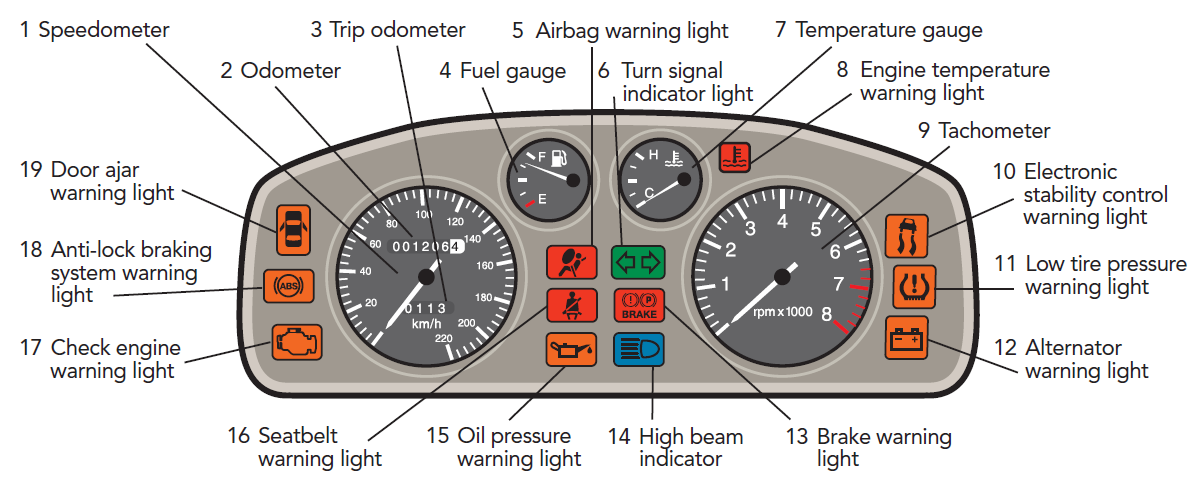

Vehicle Front and Rear View


More advanced knowledge
-
Understanding how the car works: This involves gaining a basic understanding of the major components of your car, like the engine, transmission, brakes, and suspension, and how they work together. This can help you troubleshoot problems more effectively.
-
Performing minor repairs: If you're mechanically inclined, you might be able to tackle some minor repairs yourself, like changing spark plugs, air filters, or brake pads. However, it's important to be confident in your abilities and have the right tools and resources before attempting any repairs.
-
Knowing your car's limitations: Every car has its own strengths and weaknesses. Understanding your car's capabilities and limitations can help you drive safely and avoid situations where you could damage the car or put yourself at risk.
Additional resources
-
Your car's owner's manual is a valuable resource that contains all the information you need to know about your specific vehicle.
-
There are many online resources and forums available where you can learn more about cars and get help with specific problems.
-
Talking to a mechanic you trust can be a great way to gain knowledge and ask questions about your car.
Understanding the Responsibility
Driving is not just a means of transport, but a privilege that comes with significant responsibilities. As a driver, you hold the safety of yourself, your passengers, and other road users in your hands. This responsibility extends beyond mere adherence to traffic laws — it encompasses an understanding and respect for the power and potential risks associated with operating a vehicle.
A thinking driver chooses to:
-
Drive Safe, Drive Aware: Stay Sharp, Avoid Impairment: Being a responsible driver means being physically and mentally prepared. Anger, frustration, fatigue, and impairment can cloud your judgment and reflexes, putting yourself and others at risk. Stay alert and focused. Emotions and tiredness can slow your reaction time, hindering your ability to respond quickly to situations on the road. Drive sober, drive clear. Drugs and alcohol are never okay behind the wheel. They significantly impair your thinking and reflexes, making you far more likely to cause a serious accident. Prioritize your well-being. If you're feeling unwell, injured, or overly tired, opt for alternative transportation to ensure everyone's safety. Remember, responsible driving requires being in the best possible condition, both physically and mentally.
-
Don't Gamble with Safety: Be a Master of Your Decisions: Every second on the road demands sharp judgment and split-second choices. Will you rush a yellow light saving mere seconds? Will you text and risk disaster for a quick message? Will you drink and drive, gambling with lives? Safe driving isn't just about rules, it's about awareness, planning, and anticipation. It's mastering the road and taking responsibility for your choices. Don't let distractions or impulses cloud your judgment. Think ahead, be proactive, and own your role as a safe driver. Remember, the best reactions are the ones you never have to make.
-
Driving License: Responsibility Unlocked: A license isn't just freedom, it's responsibility: to yourself, your passengers, and everyone on the road. Know your limits: Understand yourself and your vehicle's capabilities. Don't push boundaries. Sharpen your skills: Continuously learn and improve your driving through practice and awareness. Protect your passengers: Enforce seat belt use for all. Ensure children have proper child seats. Remember the stakes: Speeding, recklessness, and distractions endanger everyone. Drive with care and consideration. Your license is a privilege, not a right. Drive responsibly, drive consciously, and arrive safely.
Ultimately, the level of understanding you need depends on your personal goals and comfort level. But even a basic understanding of your car can help you be a safer and more informed driver.
Comparison between automatic and standard (manual) transmissions
| Feature | Automatic Transmission | Standard (Manual) Transmission |
|---|---|---|
| Operation | Gears shift automatically. | Driver manually shifts gears using a clutch and gear stick. |
| Learning Curve | Easier for beginners to learn and use. | Requires learning to use a clutch and shift gears. |
| Fuel Efficiency | Modern automatics are much more fuel-efficient than in the past. | Traditionally more fuel-efficient, but the gap is closing with modern automatics. |
| Control | Provides a more relaxed driving experience without the need for manual gear changes. | Gives the driver more control over the vehicle's performance and power output. |
| Cost | Generally more expensive to buy and repair. | Usually cheaper to buy and maintain. |
| Fuel Economy | Improving with technological advances, but can be less efficient in older models. | Can be more efficient, especially in highway driving, but depends on the driver's skill. |
| Driving Experience | Considered more convenient and comfortable, especially in heavy traffic. | Preferred by enthusiasts for the engaging driving experience. |
Protecting Your Vehicle From Theft: Simple Steps, Big Impact
Vehicle theft is a major concern, especially in public housing carparks. This guide outlines crucial steps you can take to secure your motorcycle or car and prevent theft.
Motorcycle Security:
Always remove keys and lock the handlebar, even for short stops.
Invest in additional security devices like wheel locks, brake locks, and covers.
Consider alarms and immobilizers for advanced protection.
Mark major parts with registration numbers or use suspension guards.
Never leave your cashcard in the ignition unit.
Car Security:
Always lock doors and windows, even for brief moments.
Never leave valuables like cash, bags, or electronics visible.
Consider alarms, immobilizers, and steering wheel locks.
Keep records of valuable item serial numbers for easier recovery.
General Tips:
Report suspicious activity around carparks to the police.
Park in well-lit areas whenever possible.
Adopt the "Lock, Look, Leave" habit: secure your vehicle, hide valuables, and park strategically.
Remember, crime prevention is a shared responsibility. Together, we can build a safer community.
By following these simple measures, you can significantly reduce the risk of vehicle theft and protect your belongings. Stay vigilant and work together to keep our community safe!
Key Points of the Motor Claims Framework
What to do in case of an accident:
Avoid unauthorized tow trucks and repair shops.
Exchange information with all involved parties: names, ID numbers, phone numbers, addresses, and insurance companies. Record vehicle details: note down license plate numbers.
Take photos:
Accident scene, including surrounding areas and all involved vehicles.
Your vehicle's damage, clearly showing the license plate.
Damage to other vehicles involved, capturing their license plates.
For multiple collisions, focus on vehicles in direct contact (front and back).
Contact your insurance company:
Call their hotline for a tow truck or advice.
Report the accident within 24 hours or the next working day, even if there's no visible damage.
Bring your vehicle (damaged or not) to an approved reporting center/workshop within the same timeframe.
Benefits of reporting promptly:
Hassle-free and quality repairs under the motor claims framework (MCF).
Avoids potentially higher costs from exaggerated claims.
Important reminders:
Report all accidents within 24 hours, regardless of severity or whether you're claiming insurance.
Failure to report with your vehicle could lead to claim rejection or prejudice.
Breaking this policy condition means the insurer has no liability and your "No Claims Discount" is lost upon renewal.
By following these steps, you ensure a smooth claims process and protect your rights under the MCF.
Bibliography
Bibliography
References
-
Department of Road Transport and Safety, Botswana
-
Basic Theory of Driving, The Official Handbook, 2019. Singapore.